Thought Leadership
Professional social writing
A useful professional post tells a specific reader what happened, what the writer learned or how to make a decision. The opening should name the subject; the body …
A useful professional post tells a specific reader what happened, what the writer learned or how to make a decision.
The body should provide enough context to assess the point. Attention alone is a poor editing goal if the text becomes vague or theatrical.
Write from a real question
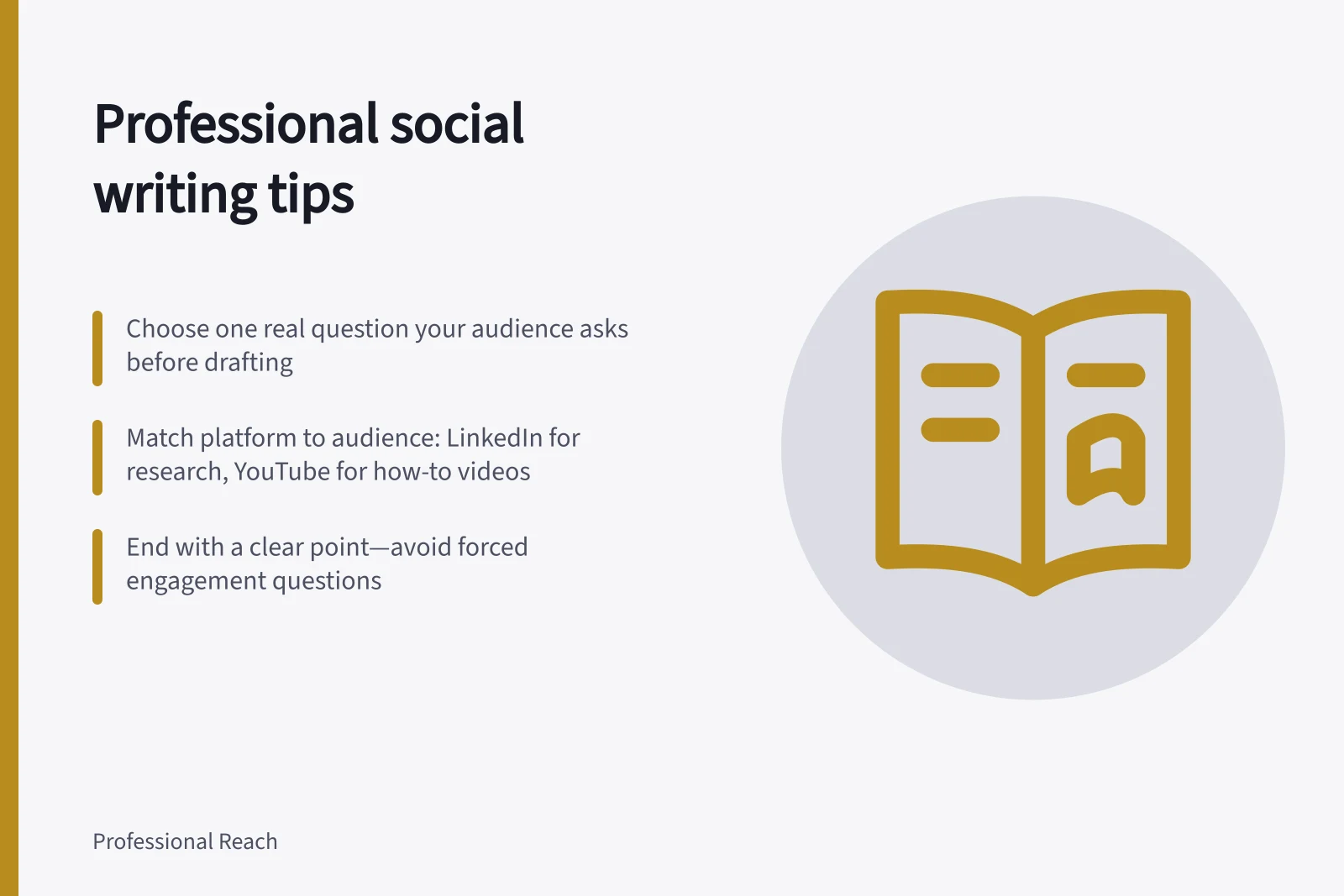
Before drafting, choose one question people in the intended profession actually ask. Write a one-sentence answer, then add the evidence or example that makes it credible.
Choose the channel for the reader
Match the platform to the people you need to reach and the material you want to share. RMIT University's guidance for researchers suggests considering your reason for using social media, what others in your discipline use, the type of content to communicate and the audience to engage.
For a professional audience, LinkedIn can be used to share informative blogs, business activities and resources, as well as research publications. Other platforms may suit different formats: YouTube is useful for how-to videos, while Instagram is centred on photo sharing.
Platform suitability for professional content in Australia
- YouTubeIdeal for how-to videos, tutorials and visual demonstrations. Suitable for training, teaching or explaining complex processes in a step-by-step format.
- InstagramBest for visual storytelling through photos and short-form video. Useful for showcasing workplace culture, events or behind-the-scenes content with strong visual appeal.
- Business Queensland (website)Recommends aligning platform choice with audience, content type and purpose; advises against hard-selling on social media.
Make the story proportional
Write a clear professional story without manufactured drama.
Draft problem / Better editorial question
- Opening hides the topic
- Can the reader identify the issue in the first lines?
- Anecdote exposes a customer
- Can the lesson be told without identifying details?
- Claim sounds universal
- What context or limitation belongs beside it?
- Ending asks for comments by habit
- What should the reader now do or understand?
Keep a consistent professional voice
Readers encounter posts alongside your other public communications, so check that the style fits your professional profile, website and other social channels. Business Queensland recommends a consistent writing style across profiles and websites, with a tone that reflects the business.
Consistency does not require every post to sound identical. Keep the underlying tone recognisable while adjusting the level of detail and format to suit the subject and platform. Social media includes text, images, video, audio, stories and live streams, so a consistent voice can carry across different forms of content.
Protect examples and relationships
Use examples without exposing confidential customer information.
State numbers only when they are real, shareable and defined. Where a result has not been measured, describe the method or decision rather than inventing a success figure.
Professional social writing checklist (Australian context)
- Use real, shareable numbers onlyIf a result is measured, state it clearly. If not, describe the method instead of inventing figures.
- Protect personal informationNever reveal customer details. De-identify data according to OAIC guidelines under the Privacy Act 1988 (Cth).
- Maintain consistent professional voiceEnsure tone aligns across LinkedIn, website, and other channels. Reflect your organisation’s identity and values.
- Avoid hard sellingFocus on value—education, practical tips, or useful resources. Promotions should be secondary.
- Align format with contentUse concise text for quick updates; detailed explanations for complex topics. Don’t force long formats on simple ideas.
Plan a useful mix of posts
A simple content plan can help you publish regularly without making every post a promotion. Business Queensland recommends creating a social media strategy with a timeline for scheduling posts, and guidelines for what is published. Use those guidelines to check that a draft is relevant to the intended audience and consistent with your professional voice.
Give readers information, education or practical interest rather than relying on hard selling. Business Queensland advises businesses to create posts and videos that interest customers and avoid posts focused on hard selling. For professional writing, make the useful information the reason to read, with any business activity or service mention kept in proportion to the post's purpose.
Set a purpose before drafting
Decide what the post should help its intended readers learn or do. A post might explain a process, share a relevant update or make useful information more accessible; the purpose should guide which details belong in the draft.
Steps to write a professional social post in Australia
- Identify a real question from your professional audienceChoose one specific question people in your field actually ask. Example: 'How do I de-identify data for research under Australian privacy law?'
- Define the purpose of the postDecide whether the goal is to inform, educate, update or guide decision-making. Ensure it supports the reader’s needs, not just promotion.
- Select the right platformMatch the medium to the audience and message—e.g., LinkedIn for formal insights, YouTube for tutorials.
- Draft with proportion and clarityAvoid manufactured drama. Use clear structure: problem → insight → takeaway. Keep anecdotes general to protect confidentiality.
- End with a meaningful conclusionFinish with actionable insight or understanding—not a forced call to comment. Let the point speak for itself.
Finish with the point
End a post without a forced engagement question.
Match the format to the content
Once the purpose and platform are clear, check that the format supports the point rather than adding decoration. If the information needs explanation, provide enough context for readers to understand it; if it is a brief update, do not force it into a longer format. Keep the post's purpose, audience and platform aligned throughout editing.
In this guide
- Opening a post with the actual subjectThe first lines of a professional post should tell a relevant reader what the post is about. A vague teaser may earn a pause but gives little reason to trust the …
- Writing a clear professional story without manufactured dramaA professional story can be useful even when nobody “failed spectacularly”. Explain the situation, the decision and what it changed, using detail that helps a peer …
- Using examples without exposing confidential customer informationA customer example can make a professional point concrete, but changing the name is not enough if the remaining details identify the person or business. Decide what …
- Ending a post without a forced engagement questionA professional post does not need to finish with “What do you think?” when the body has already made its point. Use the ending to complete the reader's …