Employee Advocacy
Part of B2B social content operations
Coordinating posts without making every voice identical
Plan related Page and employee posts with distinct reader questions, shared facts and clear timing while keeping each willing author's own voice.
Coordinate facts, release timing and responsibilities across related posts. Give each contribution a distinct reader question; let its willing author decide what to say. If drafts give the same answer in similar words, combine them or change the plan.
Map the contributions together
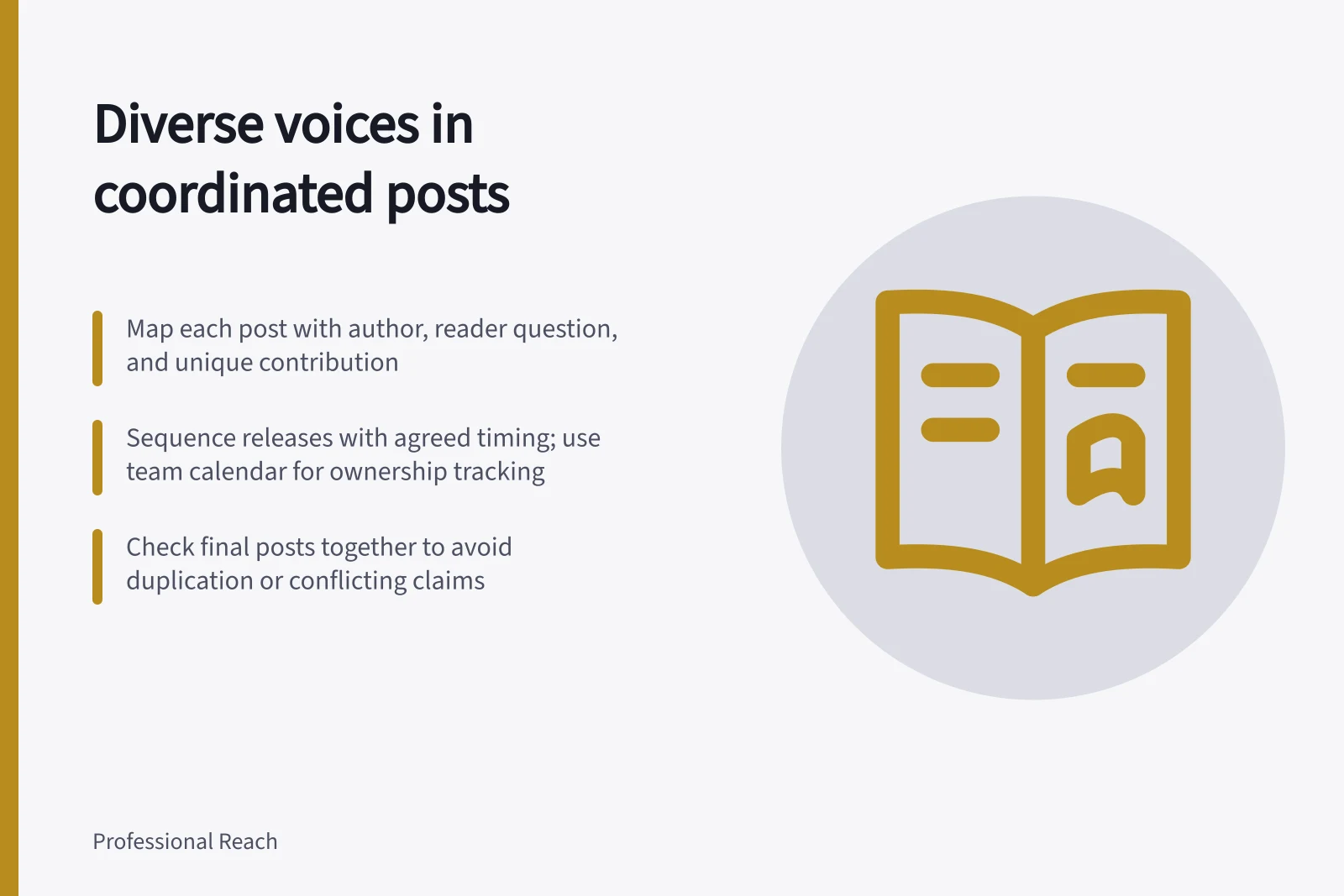
Before drafting, create one line per proposed post: author or Page, intended reader, question, specific contribution, confirmed facts and planned timing. Read the lines side by side. The test: would a reader learn something different from each contribution?
For a hypothetical service change, the Page might explain the confirmed change and who is affected. A practitioner might explain a separate decision it raises in their work. A second Page caption repeating the announcement needs a clearer purpose. These are illustrative editorial roles, not claims about a real service.
Keep organisational facts and disclosure limits consistent. Within those boundaries, the author chooses their own reasoning, examples and wording. Do not supply first-person experience they did not have, or treat fact-checking agreement as agreement to publish.
Sequence what is ready
Agree when information becomes public, especially if a contributor has seen a proposed change before announcement. A Page statement may come first; an individual explanation can follow once its author is ready and the facts are confirmed. Everyone need not post on the same morning.
Show planned and approved work separately in the team calendar. Name who owns each release and who answers official questions. If a late edit adds a customer, performance or availability claim, route it for review before the post goes live.
LinkedIn lets Page super and content admins schedule eligible Page posts. Its documented Page workflow excludes events, multiple-photo posts, reshares, polls, jobs and service posts. A Page draft saved by one admin cannot be viewed or published by another admin. Keep agreed copy in a team-controlled record when a handover is possible, and check the actual format before committing to a release time.
Post Release Sequence: Aligning Timing Without Uniformity
- Pre-announcement
- Internal review and fact confirmation; contributors may see drafts if needed.
- Page announcement first
- Official statement published by LinkedIn Page admin; sets the public record.
- Individual follow-ups
- Employees post later, sharing personal insights based on the same facts.
- Post-release tracking
- Record which posts used company facts; update authors if details change.
Key Facts from LinkedIn’s Admin Guidelines
- Posts that can be scheduled by Page admins
- Standard Page posts only
- Posts excluded from scheduling
- Events, multiple-photo posts, reshares, polls, jobs, service posts
- Draft access between admins
- Not permitted; each admin can only view their own drafts
- Reposting with personal thoughts
- Supported; added claims must be fact-checked
Check the posts as a set
Read the proposed posts side by side once more. Do they duplicate an answer, contradict a condition, or imply one employee speaks for the whole organisation? A person's post may be shorter, more technical or more tentative than the Page statement while using the same accurate company facts.
An author may also repost an eligible public post with their own thoughts; LinkedIn supports that option. Added words can introduce a new company claim, so check those facts while leaving the decision and personal judgement to the author.
After release, record which posts used a company fact. If it changes, alert affected authors and the Page owner. Each publisher can then assess an accurate, visible correction for their own post. Coordination succeeds when readers can tell why each contribution exists and who is speaking.