Thought Leadership
B2B thought leadership content
Plan B2B thought leadership around a reader decision, a supported perspective and clear limits. Review the argument before choosing a format.
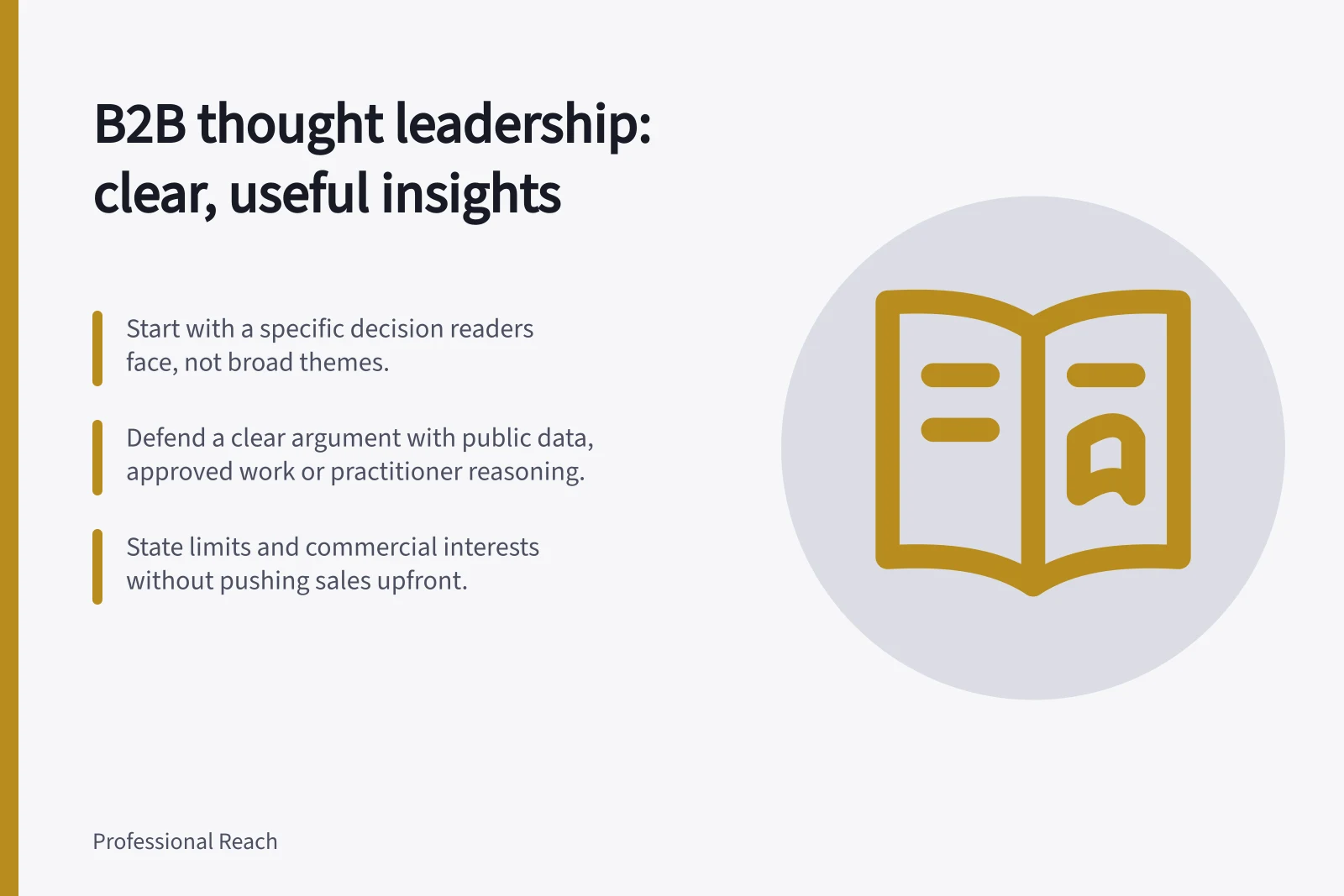
B2B thought leadership content helps a professional reader think through a problem using a perspective the author can explain and support. Start with a decision the reader faces, make a specific argument, show its basis and state where it may not apply. Publishing can benefit the company, but readers should get a useful answer without needing to enquire about its services.
Key facts about B2B thought leadership in Australia
- ASIC regulatory guidance
- INFO 269 applies to influencers discussing financial products online
- AASB standards reference
- Australian Accounting Standards Board guides for financial reporting
- Content success metric
- Useful insight over promotion – readers should gain value without contacting sales
Choose a question within your expertise
Begin with a question your people can answer from work they actually do. An operations specialist might explain what makes a supplier handover difficult to approve; a firm without direct knowledge of that process should choose another subject. These are possible editorial topics, not accounts of particular projects.
Write a brief for each proposed piece:
- Reader and decision:
- Who is doing the work, and what must they decide?
- Working answer:
- What judgement can the author defend?
- Basis:
- Which public information, approved work or practitioner reasoning supports it?
- Limit:
- What would change the answer?
- Commercial interest:
- Where does the organisation have a stake readers should recognise?
A broad theme such as “the future of procurement” leaves too much unresolved. “When should a temporary supplier exception return for approval?” gives the writer a decision to examine. The answer would still need to acknowledge that approval rules differ between organisations.
Test for a distinctive contribution
A subject can be relevant and accurate yet offer no reason to read your piece rather than another account of the same issue. Before commissioning it, identify the insight, expert judgement or experience that gives the argument a distinctive angle and could change how the intended audience understands the decision.
Check that the idea is more than a display of expertise. It should help readers navigate a real complexity or make an informed choice. If the proposed contribution merely summarises familiar information, sharpen the argument or choose a question where your practitioners can add something meaningful.
Develop a perspective
An argument needs more than a claim that a topic matters. Explain the trade-off, the condition that changes your recommendation and the reasoning behind your choice.
If you recommend earlier technical review, say which decision it informs and what the review costs in time or effort. Readers can then assess the advice in their own setting.
Practitioner experience can reveal a useful lesson, but one project does not establish an industry-wide pattern. Describe the task and reasoning you can share, and distinguish what the team observed from what it inferred. If the example cannot be disclosed, use a clearly labelled hypothetical scenario instead of disguising a real customer.
For an industry opinion, make clear what supports it and avoid claiming more than that support can establish.
Choose a form that fits the idea
Thought leadership can take different forms, including articles, white papers, case studies, videos and webinars. A webinar can discuss a specific topic in more depth; a written piece can set out an argument for readers to consider at their own pace. Choose a form that lets the reasoning and relevant detail come through; the format should serve the reader’s question.
Give the reader the argument before the offer
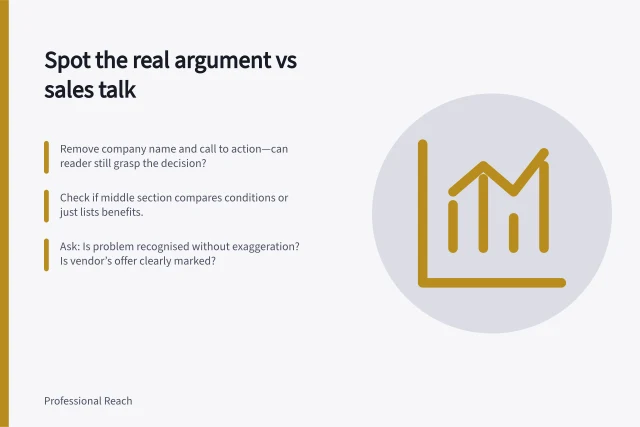
A useful piece can discuss a product category or acknowledge the publisher’s own approach. Keep the main reasoning available to readers who will never buy from the company. State the decision criteria and limitations before describing how an offer fits them. If every problem becomes a reason to contact sales, reconsider the piece’s purpose.
For example, a hypothetical software firm could explain when a manual exception log is sufficient and when a team might need a more controlled process. It could also explain conditions under which its software would be unnecessary. A separate product page can set out its features and availability.
Some subjects carry specific legal obligations. ASIC’s INFO 269 is for social media influencers who discuss financial products or services online and AFS licensees who use influencers.
It explains that financial services laws may apply; those carrying on a financial services business generally need an Australian financial services licence unless exempt or authorised as a representative. Influencers should ensure their content is accurate and balanced, and seek legal advice if unsure of their obligations.
Review the argument
Before publication, ask someone with relevant subject knowledge to challenge the claims. Ask another reader to identify the recommendation and its limits without help from the author. Cut sentences that announce expertise without demonstrating it. Check that examples are shareable and that any numerical claim retains its definition and period.
Trace each recommendation back to the evidence or experience offered. Does that support the stated conclusion? Have you marked any assumptions that remain untested?
Check whether the context remains current as well as whether the claims remain supportable. Industry trends can change the circumstances in which advice applies; revisit a piece when those changes affect its assumptions or recommendation. Updating relevant content helps readers assess whether its argument still fits their situation.
In this guide
- Turning practitioner experience into a specific lessonExtract one defensible lesson from a practitioner’s work by separating the decision, observation and limits of a shareable example.
- Supporting an industry opinion with evidenceCheck the claim, source scope, date and uncertainty before using evidence in an industry opinion. Keep interpretation separate from observation.
- Removing generic leadership slogans from a postReplace broad leadership slogans with a decision, method or condition readers can use. See a practical line-by-line editing test.
- Distinguishing a useful argument from a sales pitchUse an independent-value test to see whether a B2B piece explains a decision or chiefly promotes an offer, then choose the right destination.