Thought Leadership
Part of B2B thought leadership content
Distinguishing a useful argument from a sales pitch
Use an independent-value test to see whether a B2B piece explains a decision or chiefly promotes an offer, then choose the right destination.
A useful argument helps readers evaluate a problem or choice even if they never consider the publisher’s offer. A sales pitch mainly asks readers to prefer that offer. Both have a place, so decide the piece’s job before calling it thought leadership.
Apply the independent-value test
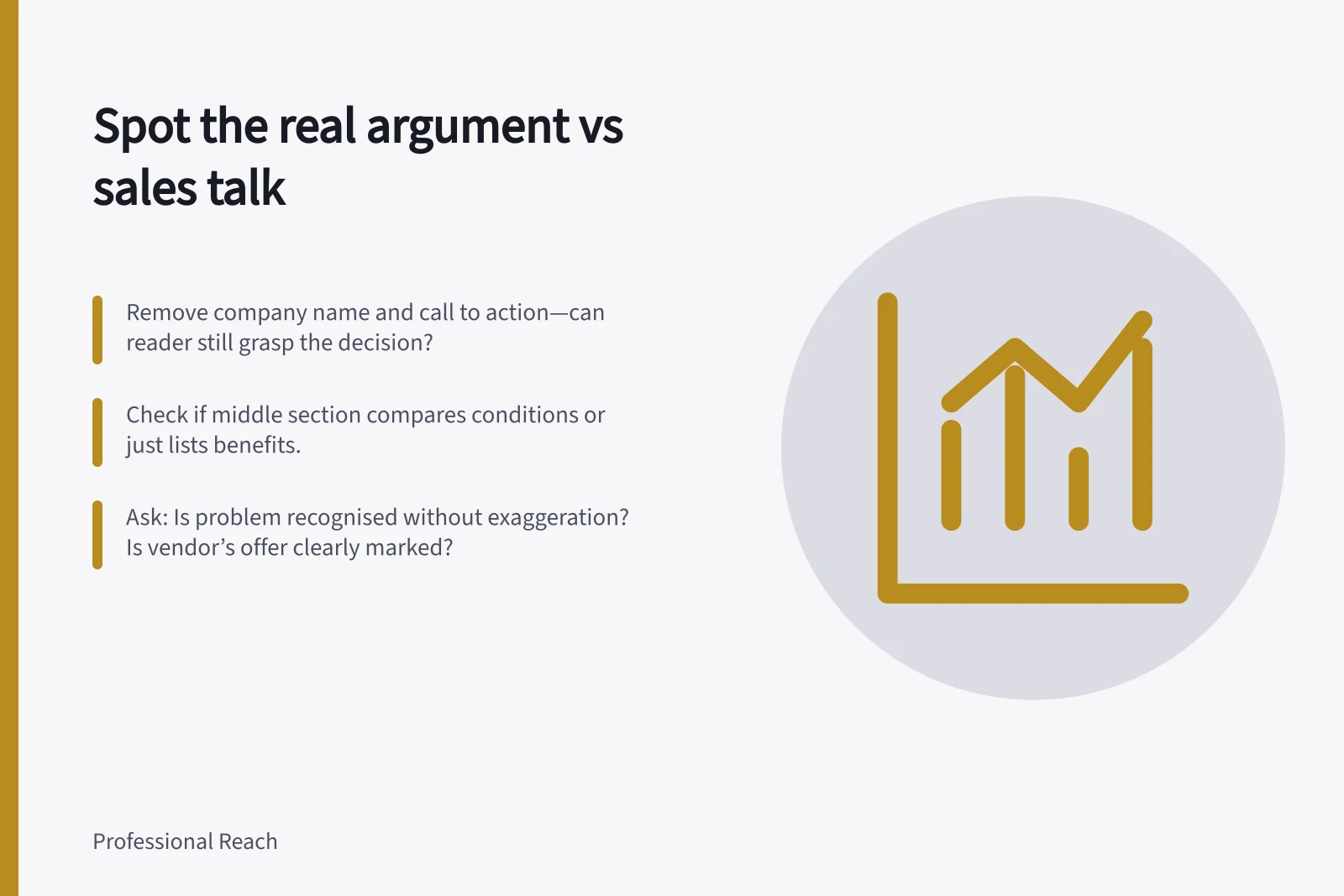
Remove the company name, product name and final call to action from the draft. Can the intended reader still identify a decision, the reasoning behind a recommendation and a limitation? If so, there may be an argument worth developing. If the remaining text says only that the problem is urgent, the piece needs more substance.
Look at what occupies the middle of the draft. A useful argument compares conditions, explains a trade-off or challenges an assumption with support. A pitch lists benefits, repeats differentiators or treats the company’s approach as the inevitable answer. A product can appear in a useful piece, but readers should see where the analysis ends and the commercial claim begins.
Check how the conclusion is earned
Imagine a hypothetical firm selling workflow software. “Manual approval is risky; book a demo of our platform” is a pitch. A more useful argument might distinguish a small team with a visible, manageable queue from a larger team that cannot easily trace exceptions.
The author would need to explain how to assess those conditions and avoid implying that every team needs software. This is an editorial example, not a tested product comparison.
Ask four questions of the draft:
- Problem:Is it described in terms the reader would recognise, without exaggeration?
- Evidence:What supports the claimed cost, frequency or consequence?
- Alternatives:Does the piece acknowledge another workable approach where one exists, and explain its limits?
- Interest:Is it clear when the writer is describing the publisher’s own offer?
A confident recommendation can still be useful. It should show why the stated conditions lead to that recommendation. If a product claim depends on current features, availability or results, verify those details before publication.
Key Questions for Thought Leadership Quality
- Problem recognition
- Is it recognisable to the target reader?
- Evidence support
- Are claims backed by verifiable data?
- Alternative consideration
- Are other viable approaches acknowledged?
- Claim transparency
- Is it clear when the writer shifts to vendor advocacy?
Give each piece an honest destination
When the draft mainly explains what the organisation sells, a product or service page may be the clearer destination. When it compares approaches, put the reader’s criteria first and identify commercial details. A thought leadership piece may end with a relevant invitation to learn more, but the invitation should not replace the promised answer.
Try reading the piece from the position of someone who will not buy this year. Would they learn a distinction they can apply?
Then read it as a potential buyer. Can they tell which claims are general analysis and which are statements about the vendor? If either reader must guess, revise the argument or relabel the piece.