Profile Craft
Part of Professional social writing
Using examples without exposing confidential customer information
A customer example can make a professional point concrete, but changing the name is not enough if the remaining details identify the person or business. Decide what …
A customer example can make a professional point concrete, but changing the name alone may not protect the customer. Remove distinctive details and combinations that could let colleagues infer who the person or business is. Keep only what the reader needs to understand the lesson.
Check the identification risk
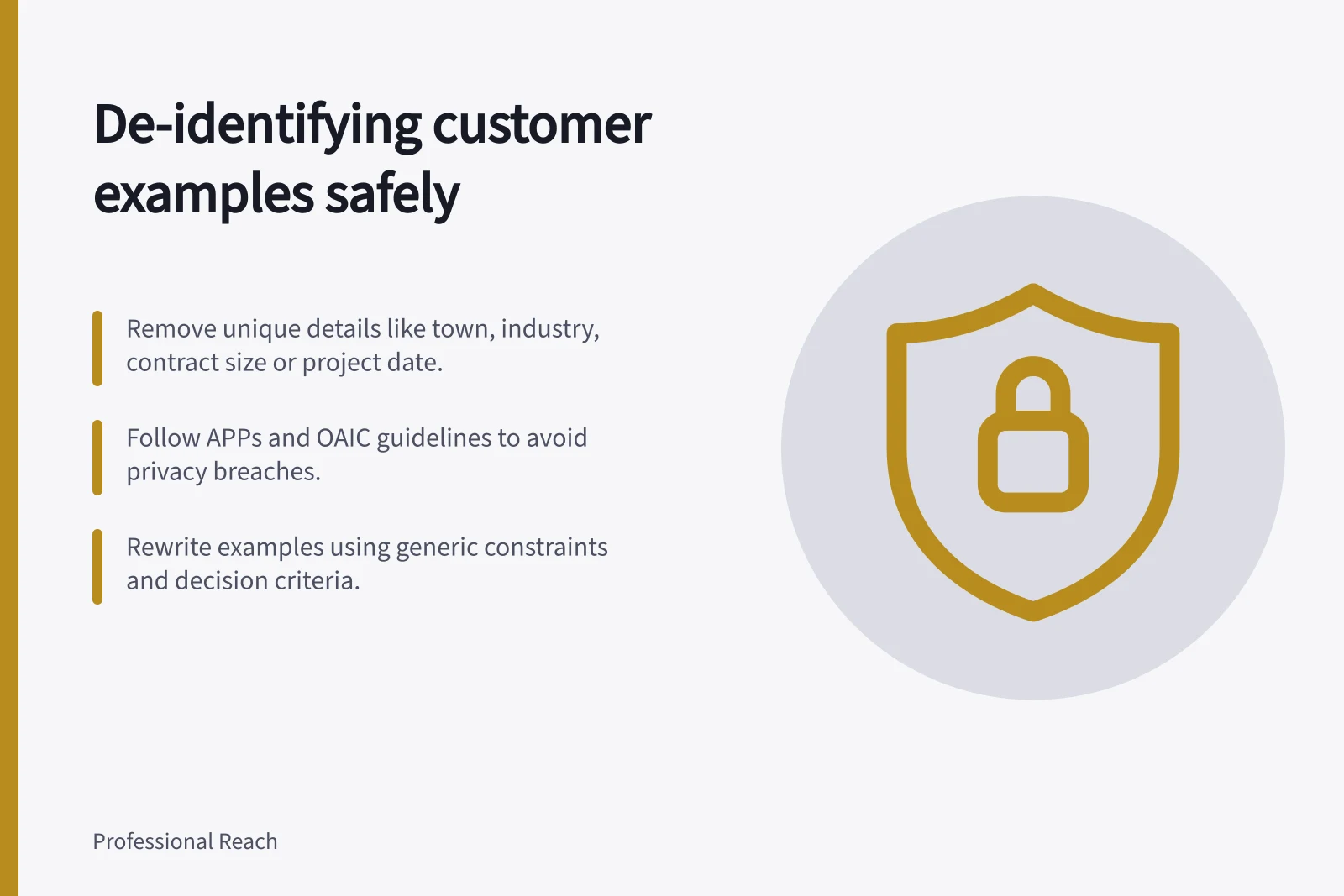
Look for a distinctive industry, town, contract size, project date, unusual failure or sequence that colleagues could recognise. Consider whether the context or combination of details could identify the customer, even when each detail seems ordinary on its own.
The Privacy Act 1988 (Cth) and Australian Privacy Principles (APPs) set legally binding standards for certain private organisations and Commonwealth government agencies. The OAIC (Office of the Australian Information Commissioner) provides guidance titled De-identification and the Privacy Act and lists its De-identification Decision-Making Framework.
Use an approved public case where possible. Otherwise, seek permission through the proper relationship owner, or write a clearly labelled hypothetical that does not imply a real customer outcome.
A composite should not be presented as a verbatim account. Remove screenshots, messages and figures unless they are approved for publication and necessary to the lesson.
Preserve the useful point
Keep the decision mechanics: what constraint mattered, which options were considered and what a reader should check in their own setting. If you cannot explain those mechanics without sensitive details, choose another example.
Template rewrite: Before — “A customer in [town], in [distinctive industry], signed a [contract size] on [project date] after [unusual failure].” After — “A customer faced [constraint]; the team compared [options] and checked [decision criterion].”
Ask someone outside the project whether they can infer who the customer is from the draft. If they can, remove or generalise more detail; privacy and contractual review may also be needed, and this editorial check does not replace either review.