Thought Leadership
Part of Organic social and sales collaboration
Sharing useful expertise before contacting a prospect
Share a useful B2B explanation, then assess the context and channel before making individual contact.
Share a self-contained answer in public so a B2B prospect can assess its value before you decide whether individual contact fits. A follow or reaction shows engagement with a subject, not an invitation to pitch; check the request, relationship and channel first.
Choose an answer that stands alone
Start with a decision the reader faces. Explain a condition, trade-off or common misunderstanding your team can substantiate, so the reader gains something useful without speaking to sales.
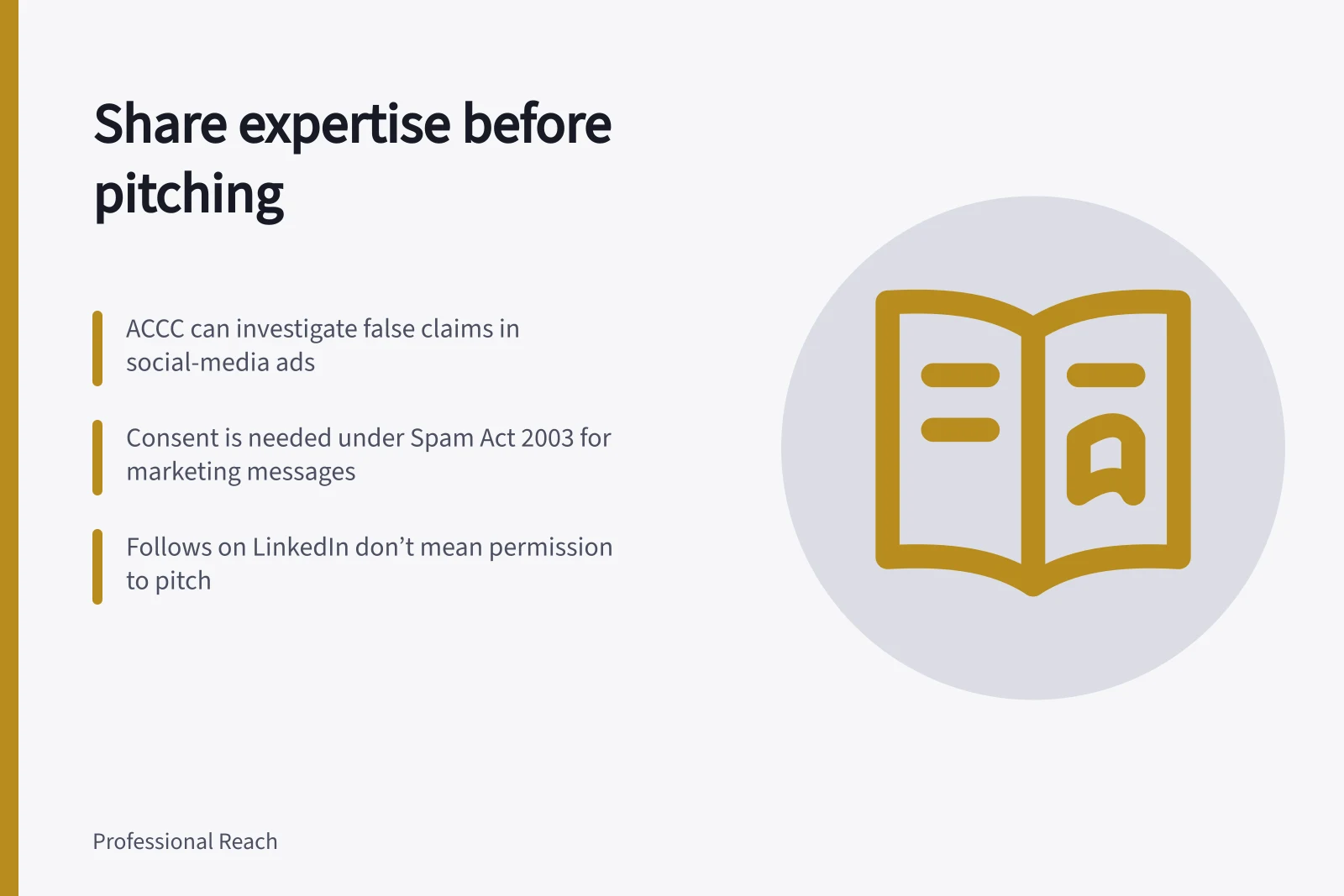
For example, a B2B prospect may ask what happens when a social-media advertising claim cannot be substantiated. Explain that the ACCC can require businesses to back up claims made on social media and may investigate or take compliance or enforcement action over false or misleading claims in social-media advertising. The ACCC does not resolve individual disputes about misleading claims.
Use questions heard by sales as prompts, then ask a subject specialist to check the explanation and its limits. One conversation does not establish a market-wide pattern, and claims about a current service need checking before publication.
LinkedIn is one place to publish expertise; other formats include a blog post, how-to guide, video tutorial, whitepaper, ebook or case study. A webinar, infographic, quiz or calculator can also help explain a topic without making individual contact.
LinkedIn Help's 'Follow and connect on LinkedIn' explains the distinction between following and connecting, while 'Post analytics for your content' covers post analytics. Review your posts as content, not as evidence that an individual reader wants contact.
How to share expertise before contacting a prospect
- Start with a decision the reader facesIdentify common challenges in your industry.
- Explain a condition, trade-off or misunderstandingUse ACCC guidelines for social media claims as reference.
- Ensure the answer stands aloneNo need to contact sales—reader gains value immediately.
- Publish via appropriate formatBlog, whitepaper, video, webinar, infographic, or case study.
- Review posts as content, not signals of interestAvoid treating likes or follows as consent to pitch.
Decide whether an approach fits the exchange
Apply four checks: what did the person actually ask, would your answer help with that request, is there a genuine relationship or invitation, and does the proposed channel fit? A public question usually calls for a useful public answer; a request to discuss someone's situation may justify offering a private route.
A follow or reaction may signal interest in a subject, but it does not establish an invitation to discuss the person's situation. LinkedIn's distinction between following and connecting is not permission to pitch.
If someone asks you to send details, use the channel they choose; for example, they might ask you to email the explanation. Before sending a commercial electronic message, check that you have consent and that the contact fits the request.
The Spam Act 2003 covers commercial electronic messages, including marketing emails, SMS, MMS and instant messages. Consent may be express or inferred when an existing relationship makes the message reasonably expected.
For privacy, identify whether your business is an APP entity under the Privacy Act 1988 and the Australian Privacy Principles. Annual turnover of $3 million or more is the key test, though businesses below that level may still be required by law to comply. ACMA issued over $16 million in spam penalties in the 18 months leading up to mid-2025.
Public vs private engagement on LinkedIn
- Pros of public response
- Demonstrates expertise, builds trust, supports SEO, avoids unsolicited contact.
- Cons of public response
- May miss personalised context; not suitable for sensitive or confidential matters.
- Pros of private approach
- Allows tailored discussion, deeper insight into individual needs.
Stop before individual contact
If the request or relationship gives you a relevant reason and the channel is appropriate, keep any direct note focused on that reason. Make it easy to decline, and do not treat engagement with your expertise as consent to repeated follow-ups.
Make claims you can substantiate. The ACCC can require businesses to back up claims made on social media, and may investigate false or misleading claims in social-media advertising.