Employee Advocacy
Employee advocacy
Plan employee advocacy around willing contributors, accurate company facts and useful audience responses without turning personal profiles into posting targets.
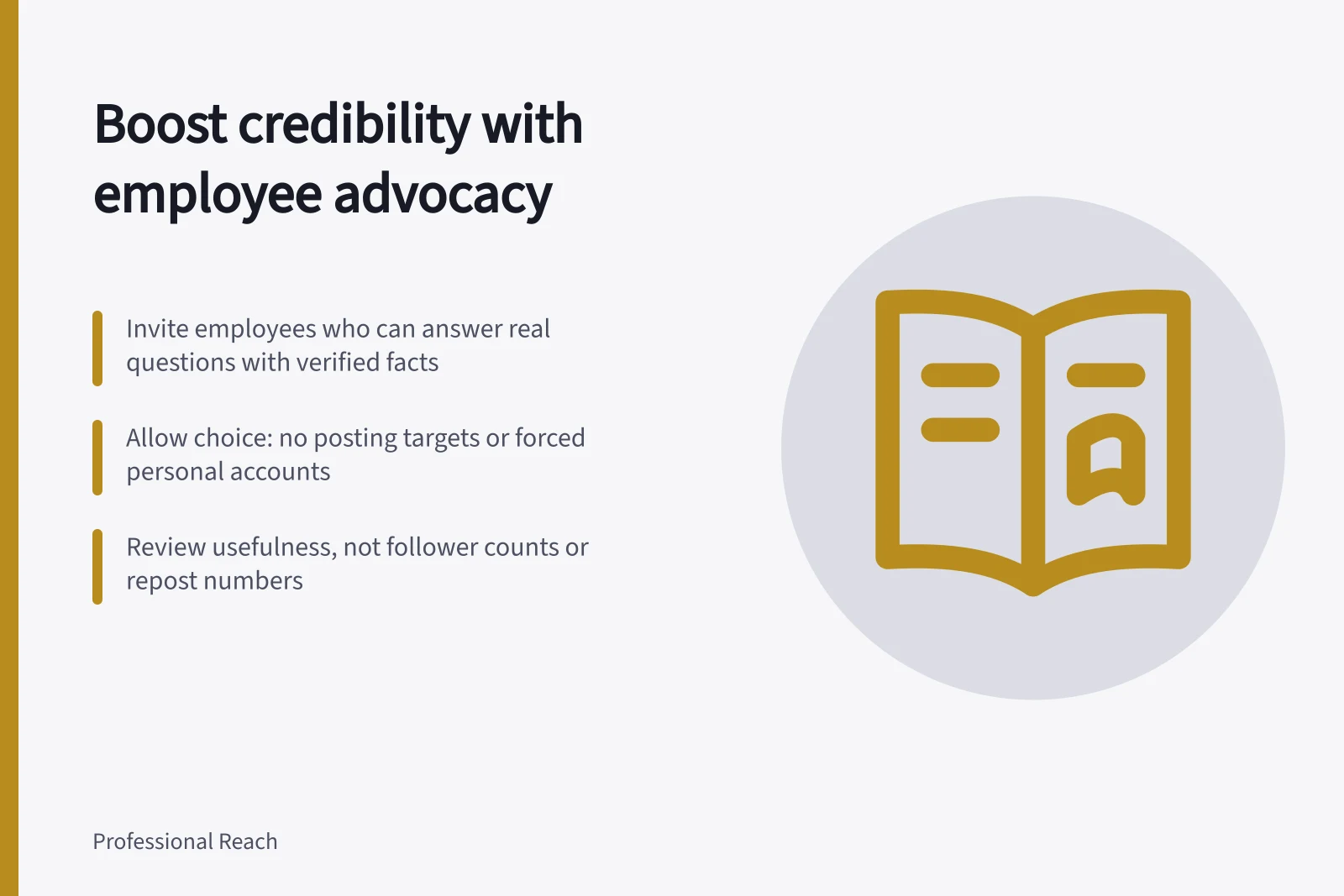
Employee advocacy is most useful when willing employees share professional knowledge or relevant company information in their own voice. Give them accurate facts, clear disclosure boundaries and a real choice about taking part. Review whether their contributions help the intended readers, rather than counting staff reposts.
Decide what the programme is for
Begin with a question an employee can answer credibly. A practitioner might explain a method they use; a service team member might clarify a common customer question. Official commitments and changes the organisation must own belong on the company Page. An employee's profile carries that person's contribution.
Write a brief naming the audience, the question, the confirmed facts and any information that must stay private. If staff would only repeat a Page announcement, ask what another copy adds for readers.
Make participation a choice
Invite people whose work gives them a useful perspective. They might suggest questions, check a fact, write an original post, add context to a public Page post, or decline. Someone can contribute expertise internally without publishing under their own name.
Agree on work time and support for contributions the organisation requests. A manager should not turn an invitation into a posting target. The employee decides whether to use their personal account and whether the finished post reflects their view. Company fact checking protects accuracy without replacing that voice.
LinkedIn provides guidance on reposting posts and offers Employee Notifications for LinkedIn Pages. Its former My Company and Employee Advocacy tabs are no longer available.
Supply facts people can use
Provide a short information pack to support accurate contributions. For detailed guidance, see the employee information pack article.
For a hypothetical service change, the Page could state the confirmed change and who is affected. A willing employee could explain a general question the change raises in their work. Neither should present a proposed date or unverified result as confirmed.
When a company fact changes, tell affected authors promptly. Help them make a visible correction where needed.
Support a repeatable process
Choose a coordinator for invitations and a fact owner for each subject. Ask willing contributors what they know and want to discuss. Check material company claims, then let the author decide whether to publish. Record fact approval separately from that decision.
Make someone available for questions the author cannot answer for the organisation. An employee should not have to defend an official statement alone; the Page can give the organisational answer.
Review usefulness without scoring people
Record the intended reader question, the contribution and any relevant follow-up. Specific questions and corrections can show where an explanation needs work, though visible responses cannot reveal what silent readers understood.
LinkedIn provides separate help pages for post analytics and LinkedIn Page content analytics. If an employee volunteers a figure, record its source and period. Do not add Page and personal impressions into a count of unique people reached, or rank employees by follower totals.
Use the review to decide whether to continue a subject, clarify a point or stop requesting a contribution that adds no useful perspective. Ask contributors whether the effort remains worthwhile for them.
In this guide
- Inviting participation without forcing employees to promoteInvite employees to contribute expertise voluntarily, offer choices beyond posting, and keep personal profiles free of repost targets.
- Giving employees accurate information they can personaliseCreate concise, verified fact cards with conditions and disclosure limits so employees can share informed views in their own words.
- Measuring advocacy without ranking staff by follower countsReview employee advocacy through useful audience responses and editorial learning while respecting private member analytics and separate Page results.