Employee Advocacy
Part of Employee advocacy
Inviting participation without forcing employees to promote
Invite employees to contribute expertise voluntarily, offer choices beyond posting, and keep personal profiles free of repost targets.
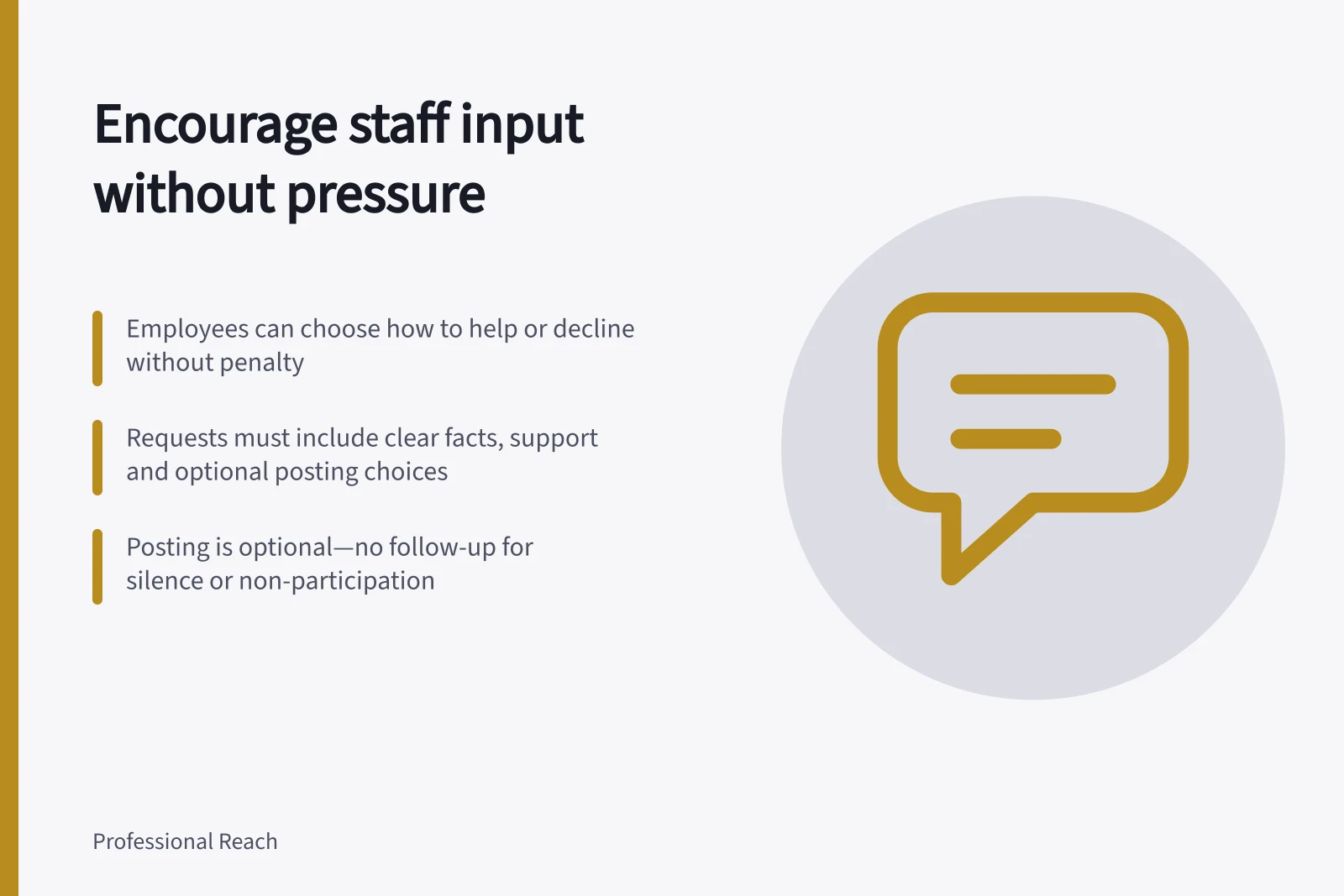
Invite employees to contribute when they can choose how to help and can decline without penalty. Explain why their perspective would help a particular audience, what support is available and which company facts need checking. Using a personal profile must remain their decision.
Key facts about employee advocacy on LinkedIn (Australia)
- Employees are more likely to participate when they control the messageLinkedIn research shows autonomy increases willingness to contribute
- Visibility of shared posts depends on audience settings and profile privacyPosts may not appear in all networks unless properly configured
Ask for a contribution, not a repost quota
Begin with the subject and the person's connection to it. A useful invitation names a question they understand, such as how a team handles an exception in a process. It does not assume they want to publish about their employer.
Offer choices. Someone may suggest a question, explain a technical point to an editor, check company facts, comment in their own words, write a post or do none of these. Agree on work time for a contribution the organisation requests, and do not treat silence as agreement.
For example: “We're preparing an explanation of how we handle service handovers. Your experience could help us identify the questions readers will have. Would you like to advise on the facts, write something in your own voice, or leave this one to the Page?”
Remove pressure from the request
A request from a line manager may carry particular weight. State that posting is optional, declining needs no explanation and personal social activity will not be used as a participation score. Send one clear invitation, not repeated reminders aimed at the same person.
Give the employee time to check facts and decide whether the wording reflects their view. If the business needs an official statement or a scheduled announcement, publish it from the company Page.
If you include a Page notification or repost link, present it as a convenience, not an instruction. Say the employee can ignore it without follow-up.
Agree on boundaries before publishing
Explain which company facts are confirmed, what cannot be disclosed and whom to ask about an uncertain claim. A fact check can correct a date or condition without scripting the employee's opinion.
Ask whether the employee is comfortable being the named author and handling possible questions. Provide a route for matters only the organisation can answer. The employee can pause a draft, withdraw from a proposed post or ask the Page to speak instead.
Before sharing, check who can see the post and whether that audience suits the author. A narrower audience does not make confidential information safe to publish.
Learn from the invitations
Ask what made participation easy or uncomfortable. Consider useful questions and internal contributions as well as published posts. If people repeatedly decline, revisit the subject, support and request before inviting them again.