Company Pages
Part of Organic LinkedIn marketing for B2B businesses
Company pages versus employee profiles
Choose between a LinkedIn company Page and an employee profile by checking who owns the claim, speaks for it and handles follow-up.
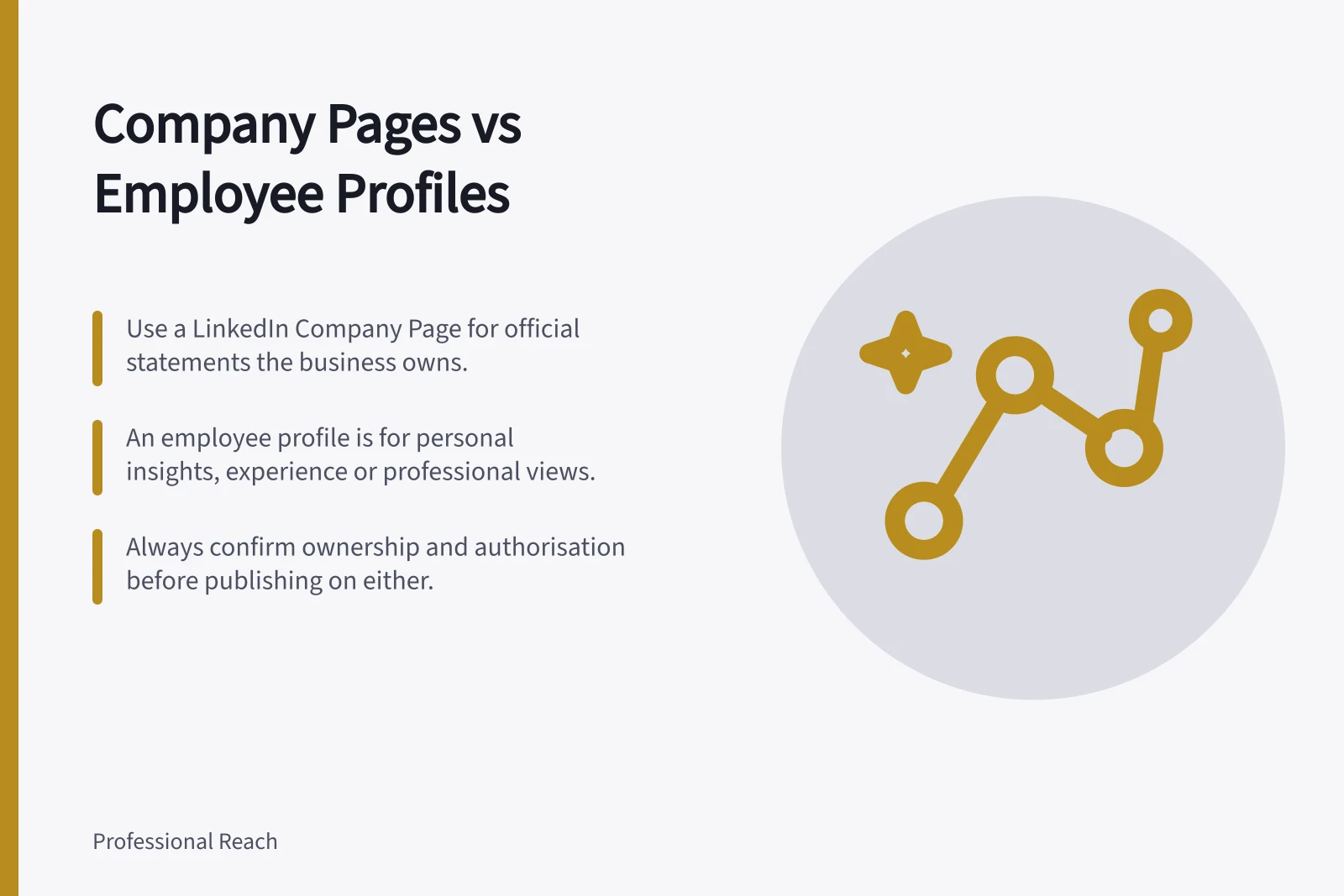
Use a LinkedIn company Page for a statement the organisation owns. Use an employee profile when a willing person explains work or a professional view in their own name. For a given post, ask who owns the claim and who should answer for it.
Choose the identity before writing
A Page represents an organisation; a profile represents a person. LinkedIn requires member profiles to represent real people and gives Pages admin roles for organisational publishing. The Page is therefore the right home for official service information, company updates and positions the business has approved.
An employee profile can carry a practitioner’s reasoning or experience, if the person wants to participate and is authorised to share the details. Agreeing on company facts can prevent errors while leaving the person free to express their own view.
| Editorial question | Company Page | Employee profile |
|---|---|---|
| Who speaks? | The organisation through a super or content admin. | The named professional. |
| Suitable contribution | An official fact, update or explanation the business owns. | The person’s method, judgement or experience. |
| Check before publishing | Can the organisation verify and stand behind the claim? | Is the person willing, accurate and authorised to share it? |
| Review | Page content and follower analytics. | The member’s post and audience analytics. |
This guide is about ownership, not a prediction of reach. On one subject, the Page might announce a process change while a practitioner explains a general decision principle without disclosing a customer’s case.
Company Page vs Employee Profile on LinkedIn
- Who speaks?
- The organisation through a super or content admin.
- Suitable contribution
- An official fact, update or explanation the business owns.
- Check before publishing
- Can the organisation verify and stand behind the claim?
- Review
- Page content and follower analytics.
- Who speaks?
- The named professional.
- Suitable contribution
- The person’s method, judgement or experience.
- Check before publishing
- Is the person willing, accurate and authorised to share it?
- Review
- The member’s post and audience analytics.
Let the two voices add different value
List the facts a proposed post needs. Mark what is public and approved, what still needs checking and what cannot be shared. Then decide whether the contribution is an organisational commitment or an individual explanation. Publish both only when each answers a different reader question.
For a hypothetical supplier onboarding change, the Page might explain what changed for clients and where questions should go. A willing operations specialist might discuss how teams can recognise an exception during onboarding. Neither contribution needs an invented result or a client’s private details.
Agree on a route for corrections. A Page admin can coordinate a correction to an organisational statement. An employee should know whom to ask if a company fact in their post is challenged. Sharing an official claim does not transfer the organisation’s responsibility for it to the employee.
When to use a Company Page or Employee Profile
- List required facts for the proposed postIdentify what is public, approved, pending review, or confidential.
- Determine ownership of the claimIs this an organisational commitment or an individual explanation?
- Publish only when each voice answers a different reader questionEnsure complementary value without overlap or confusion.
- Agree on a correction routePage admins handle organisational corrections; employees know whom to contact if facts are challenged.
Review each identity on its own terms
LinkedIn provides Page analytics and separate analytics for members’ posts and audiences. Related terms such as impressions and engagement describe different publishing identities. Record the author, topic and purpose beside each post before interpreting responses.
A successful personal post does not, by itself, establish that the Page is serving its audience; Page follower growth does not describe an employee’s professional relationships.
Choose the Page for accountable organisational information and a profile for a person’s own contribution. Use both when they give a reader complementary answers with clear ownership of the facts.
Key Analytics by Identity on LinkedIn
- Page analytics
- Track follower growth, impressions, engagement for official content.
- Member post analytics
- Measure reach, engagement and audience insights for personal contributions.
- Audience distinction
- Page success does not reflect personal influence; vice versa.