Employee Advocacy
Part of Professional audience development
Avoiding generic connection messages
Write a short, truthful connection note that explains your shared professional context without a disguised sales pitch.
A connection message should identify a real point of contact and a modest reason to stay in touch. If the same text could go unchanged to fifty strangers, it tells the recipient little about why you chose them. Write the context first; remove every phrase that merely announces you want to expand your network.
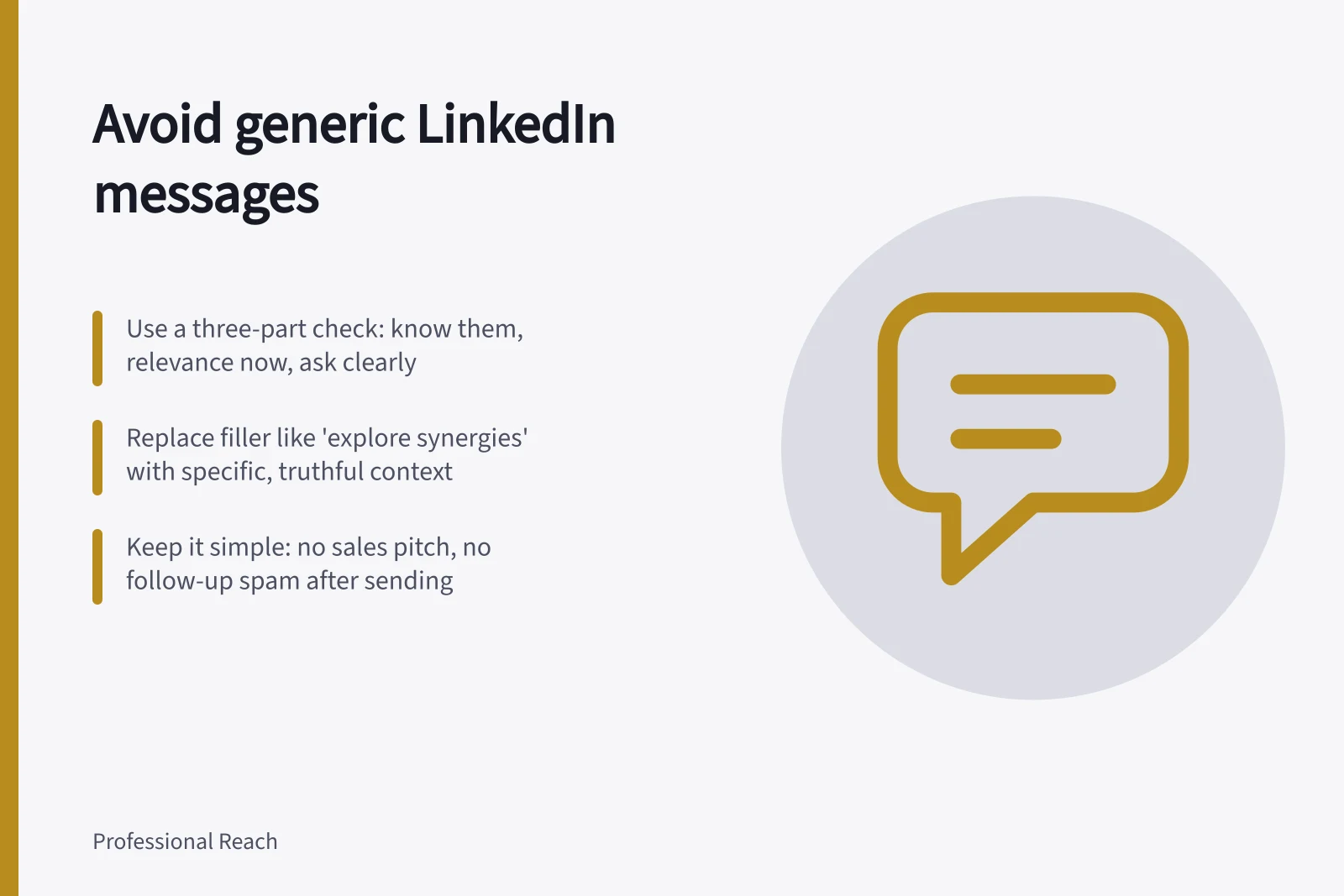
Use a three-part check
Before writing, answer three questions: How do you know the person? What conversation or work makes the connection relevant now? What, if anything, are you asking them to do?
Often the last answer is simply “accept if you would like to stay in touch”. An invitation does not need a meeting request, a product description or a paragraph about your career.
For someone you met, a concise note might read: “We spoke at yesterday's procurement forum about supplier handovers. I appreciated your point about documenting exceptions and would be glad to stay in touch.” This is an illustrative message, not an account of an actual event.
Its value lies in the specific, truthful reminder. If that exchange did not happen, the wording would be misleading.
For a former colleague, name the shared project or period you can both recognise. For a person whose work you only read, consider following instead of inventing a connection context. A polished note cannot substitute for a relationship that is absent.
Remove the familiar filler
“Let's connect and explore synergies” gives no reason to accept. So does a long compliment followed by a request for fifteen minutes.
Replace generic praise with the actual subject you discussed, or leave it out. Avoid saying “I have been following your work for years” unless that is true and relevant.
Read the note from the recipient's position. Can they recognise the encounter without searching your profile? Is the request small enough for the relationship? Does any sentence conceal a sales approach?
If the invitation would surprise them, a different action may be more appropriate.
Prioritise clear context, and never treat a short note as a reason to send a generic invitation to someone who does not know you.
Let the message end
After sending, allow the recipient to decide. An acceptance means the connection is in place; it does not establish buying interest.
If they respond with a question, answer that question. If they do not respond, do not turn the invitation into a sequence of automated follow-ups.
The best final edit is often deletion. Keep the true reminder, the relevant reason and a courteous close.
Before sending, check that every sentence would be true only of this recipient, and that nothing reads as a disguised pitch.