
Profile Craft
Part of Building a useful professional profile
Explaining expertise without inflated claims
Describe professional expertise through actual responsibilities, clear scope and evidence without overstating a role or result.
Explain expertise by naming the work you have done, the part you owned and the conditions in which your experience applies. Readers should be able to tell a demonstrated capability from a subject you are learning or a result you cannot personally claim.
Replace labels with observable work
Labels such as “expert”, “visionary” and “industry leader” ask readers to accept your self-assessment. Start with a task instead: what problem do you handle, for whom and in what setting? “I prepare handover documentation for multi-site operations teams” gives a clearer basis for a conversation than “I transform operations at scale”.
Then add a useful boundary. Did you work on implementation, review, research or management? Were you responsible for the whole project or one stage? A profile can still show strong expertise when it states a narrower contribution accurately.
How to explain expertise without inflated claims
- Replace vague labels like 'expert' or 'visionary' with specific tasks
- Specify the problem, audience, and setting of your work
- Clarify your roledid you lead, design, implement, advise, or support?
- Avoid claiming team results as personal achievements
Pros and cons of using strong labels in professional profiles
- Pros
- Cons
Keep the verbs proportionate to your role
Use verbs that identify your contribution. “Led” suggests responsibility for direction; “designed”, “analysed”, “implemented”, “advised” and “supported” describe different work. Choose the one you could explain to a former colleague without changing the story. For a team result, separate the team’s outcome from what you did: “I developed the review checklist used by the project team” is clearer than claiming the entire project as a personal achievement.
If you cite a result, check who measured it, the period covered and whether you may share it. A number without definition or context can exaggerate a modest observation. When the result is private or unmeasured, describe the method and decision instead. There is no need to manufacture a percentage.
Match the claim to the profile section
On LinkedIn, the headline is the short introduction below your name, the About section explains your work in more depth, and Experience holds the positions behind that description. The headline can differ from your formal job title. Use that flexibility to describe your actual work, while keeping the Experience entry accurate.
For an About draft, state the work you do and the setting you know, then add one or two responsibilities or methods. If it matters, name the limit of your experience or your current focus. If a sentence could fit almost anyone in your profession, add the task or condition that makes it yours.
How to craft a credible expertise statement on LinkedIn
- Start with your headlinedescribe actual work, not just title
- In the About sectionstate context, tasks, and methods used
- In Experiencelist roles accurately with clear responsibilities
- Add limits or focus areas where relevant (e.g., ‘focused on mid-market clients’)
Let evidence set the ceiling
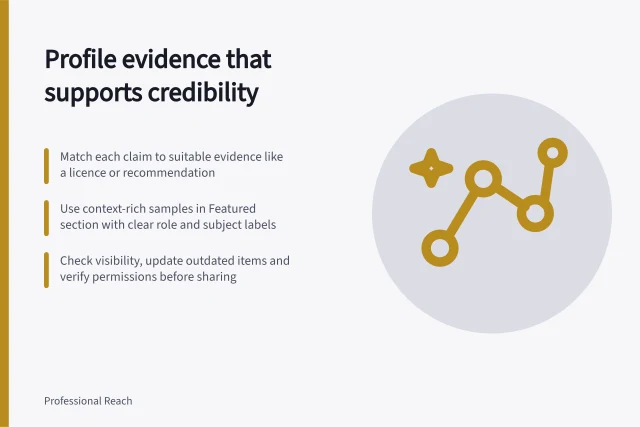
Before publishing a claim, ask what a reader could inspect or a colleague could accurately confirm. An approved work sample, a specific role description or a recommendation grounded in direct collaboration can support different parts of the story. A skill endorsement alone does not explain what you did or how well you did it.
Review implied claims as well as explicit ones. Does “specialist” suggest a depth your experience supports? Does “advised national clients” describe your own role or the firm’s client list?
Where the answer is uncertain, narrow the sentence. Give readers enough detail to judge the work.
Key LinkedIn profile elements that support credible expertise claims
- Approved work samples
- Specific role descriptions
- Recommendations from direct collaborators