Thought Leadership
Part of B2B organic social programme reviews
Testing a narrower professional topic
Define a specific professional decision, publish distinct answers and review relevant responses before committing to a narrower social topic.
Test a narrower professional topic by defining one reader, one recurring decision and the conditions that make an answer useful. Publish a small set of distinct, verified answers, then examine the questions they prompt and the effort they require.
Use the result to decide whether to develop the subject further. Do not claim a topic change caused a change in reach or enquiries.
Test a narrower professional topic
- Define one reader, one recurring decision and the conditions for a useful answer
- Publish a small set of distinct, verified answers
- Examine the questions prompted and the effort required
- Decide whether to develop the subject further
Define the working topic
A broad theme such as “better equipment maintenance” leaves a writer many directions. A narrower working topic might be “when a site manager should escalate an inspection finding”.
This is an invented editorial example, not maintenance advice. It names a reader and a decision, while leaving the real answer for a qualified source to verify.
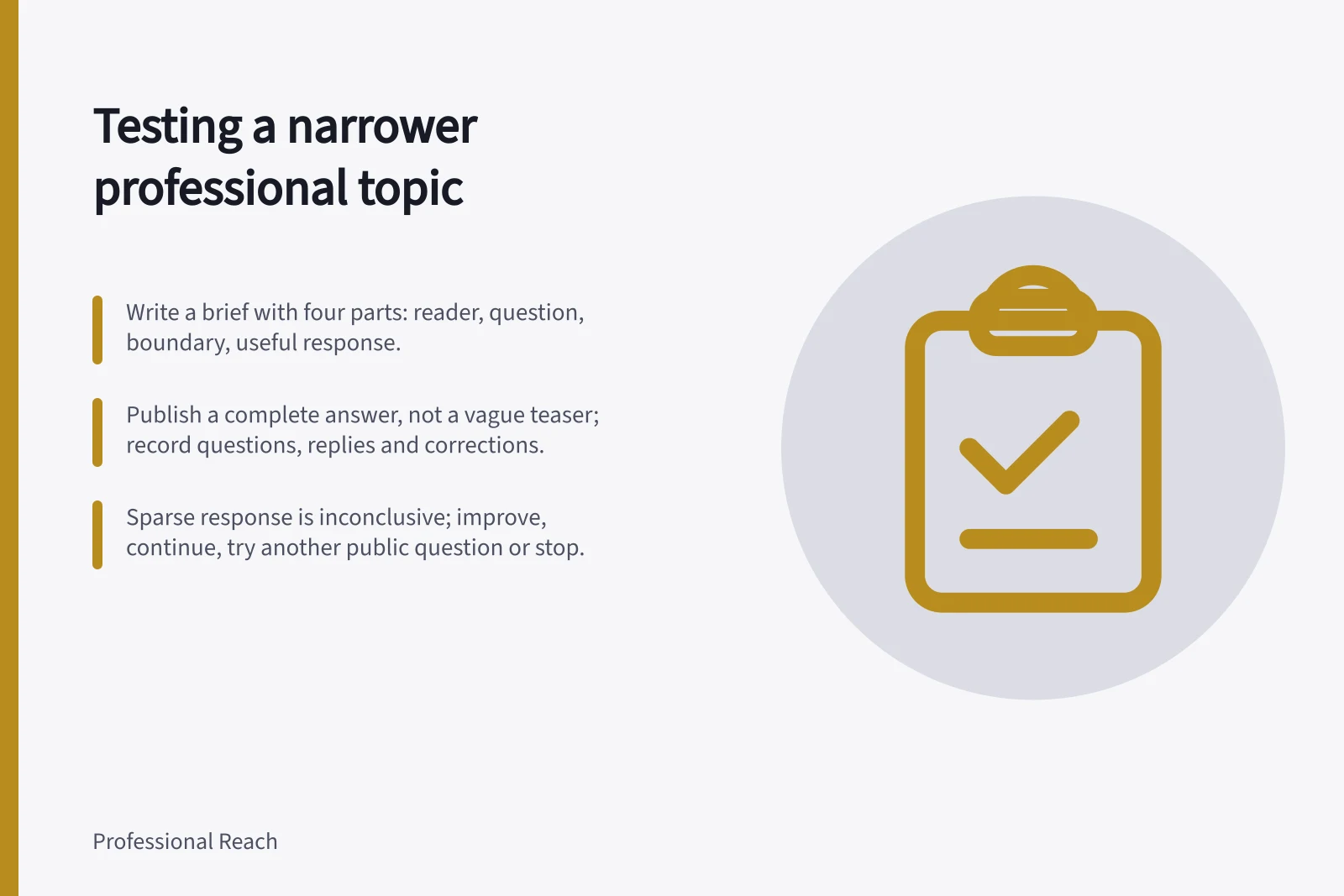
Write a brief with four parts:
- Reader:Who faces the decision? A job title alone does not prove a person’s exact task.
- Question:What can the team answer accurately and publicly?
- Boundary:Which conditions require another answer or specialist review?
- Useful response:What question, correction or relevant enquiry would inform the decision to continue?
Sketch distinct questions before publishing. A series that repeats one warning has not tested the topic’s breadth. Check the basis of any advice before it appears.
Working topic brief
- Readerwho faces the decision?
- Questionwhat can the team answer accurately and publicly?
- Boundarywhich conditions require another answer or specialist review?
- Useful responsewhat question, correction or relevant enquiry would inform the decision to continue?
Keep observations interpretable
Choose a manageable period and record which posts belong to the test. Keep the publishing identity and distribution approach reasonably consistent where practical. Note exceptions, such as one boosted contribution.
If the topic appears on a company Page and a willing employee’s profile, report their results separately.
Publish a complete answer rather than a vague teaser designed to draw comments. Record the question each contribution addressed, substantive replies, corrections and the work required to prepare and maintain it.
Treat any reach figures as one part of the review, not proof that a reader needed the answer. Consider the questions prompted and the work required alongside any available figures.
Keep observations interpretable
- Choose a manageable period and record which posts belong to the test
- Keep the publishing identity and distribution approach reasonably consistent where practical
- Note exceptions, such as one boosted contribution
- Report company Page and employee profile results separately
- Publish a complete answer rather than a vague teaser
- Record the question each contribution addressed
- Record substantive replies, corrections and the work required to prepare and maintain the answer
- Treat reach figures as one part of the review, not proof of need
Decide whether to continue
Review the set together. Did the contributions answer different parts of the decision? Did a relevant question reveal another answer the team can verify? Does the subject depend on private facts the team cannot publish? Can the team keep the answers accurate as circumstances change?
Sparse response is inconclusive. The next choice may be to improve a weak explanation, continue observing, try a different public question or stop the test.
If the subject needs frequent specialist updates, a single maintained explanation may serve readers better than a recurring social series. Record the reason for the choice and what remains unknown.
Decide whether to continue
- Did the contributions answer different parts of the decision?
- Did a relevant question reveal another answer the team can verify?
- Does the subject depend on private facts the team cannot publish?
- Can the team keep the answers accurate as circumstances change?
- Is sparse response inconclusive, prompting another choice rather than a firm conclusion?