Content Operations
Part of B2B organic social programme reviews
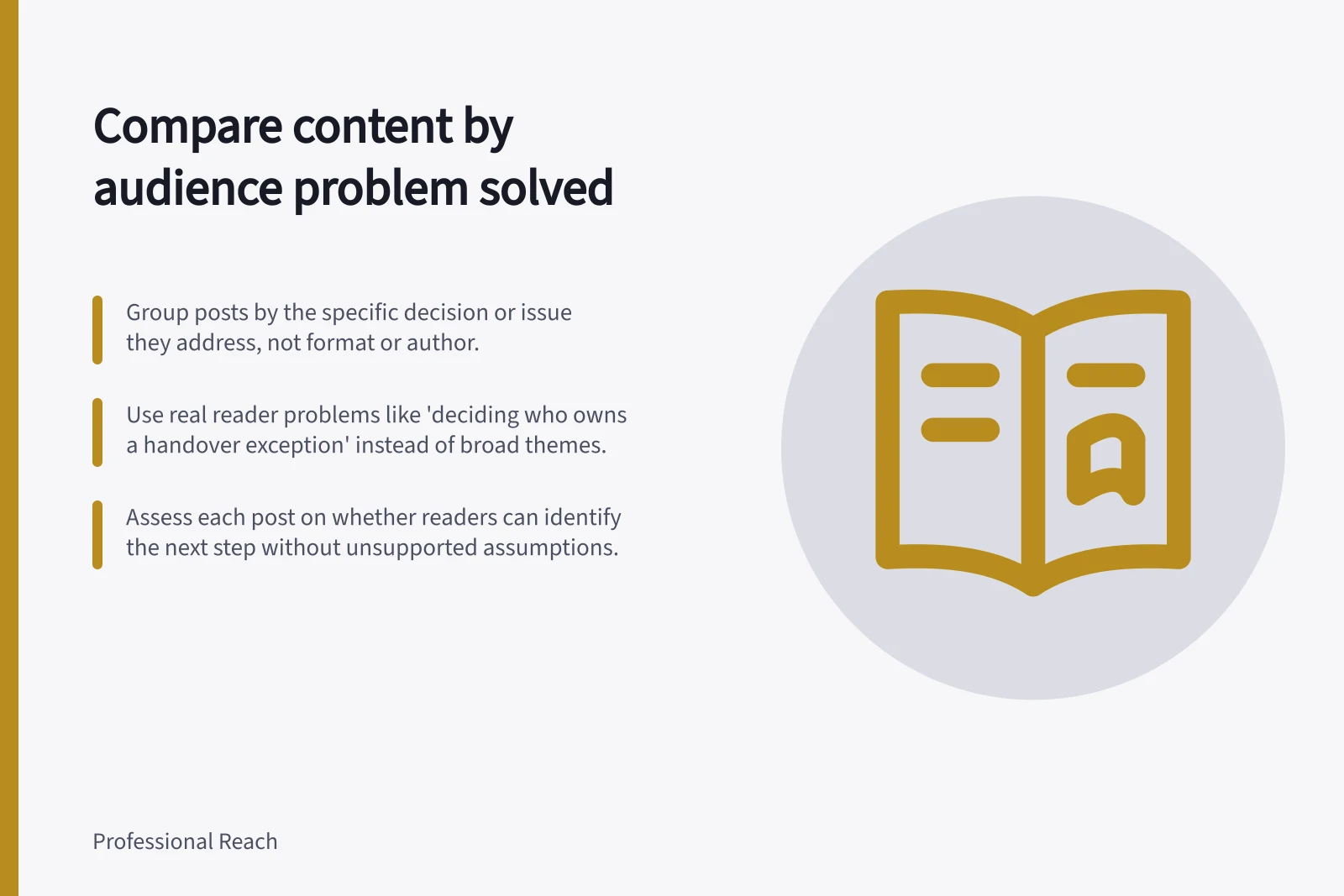
Comparing content by the audience problem it solves
Group B2B social content by the reader problem and decision it addresses, then compare answer quality, responses and gaps.
Compare published organic social content by the question or decision it helped an intended reader address. Grouping posts by format, author or impressions first can mix unlike answers. Label the reader problem and the role each contribution played, then compare answers within those groups.
Build groups from what was published
Read each contribution and complete this sentence: “This helps [reader] decide or understand [specific issue].” Use the published answer, not just its planning label. A post planned as supplier-handover advice may actually be a service announcement; group it by the job it does.
Keep the problem narrower than a broad theme. “Operations” is a theme; “deciding who owns a handover exception” is a problem. Record the intended role as well, because a practitioner and a manager may face different parts of the same decision.
| Hypothetical contribution | Reader problem | Job of the contribution |
|---|---|---|
| Signs that a routine handover has an unresolved exception | A practitioner needs to recognise when routine steps are insufficient. | Help identify an issue. |
| Factors in choosing an exception owner | A manager needs to assess who can resolve it. | Help assess a choice. |
| Notice of a changed contact route | An existing client needs the current route for help. | Communicate a confirmed change. |
These invented contributions share a subject, yet they are not three attempts at the same answer.
Compare usefulness within a group
For each contribution, ask whether the intended reader can identify the decision, find the condition that matters and understand the next step without an unsupported assumption. Note corrections from a qualified reviewer.
Read comments and enquiries for a missing step, exception or question the answer left open. A response represents the person who made it, not the whole audience.
Add distribution context without turning it into an editorial score. Record the publishing identity, observation period and paid distribution before placing figures side by side.
If only one contribution addresses a problem, assess that answer without inventing a comparison. If several posts address different stages of one decision, consider whether they make a useful sequence.
Choose what to answer next
A problem group may reveal repetition, a missing answer or an update that has served its purpose. If several posts restate the same warning, the next piece may need to explain a condition readers can use.
If readers ask what happens after an initial check, verify and answer that next step. A company update need not repeat itself to compete with an explanation for impressions.
Record the problem, what existing content answered, what remains open and the proposed next answer. This comparison supports an editorial choice; it does not claim platform figures measure comprehension.