
Programme Reviews
B2B organic social programme reviews
Review a B2B organic social programme through audience fit, relevant responses and effort, then set editorial and resourcing priorities.
Review a B2B organic social programme against the audience and purpose it was meant to serve. Examine the work published, the responses it prompted and the effort it required. Finish with programme priorities and activities needing a closer decision. Total impressions alone cannot provide that decision.
Set the review boundary
Choose a period with enough work to examine. Record changes that affect comparison, such as a new subject or paid promotion. State the intended audience and purpose as they stood at the start of the period, and do not redefine them after seeing the results.
List posts and recurring activities, including relevant public replies that did not become posts. Record publishing identity, intended reader, question addressed, date, distribution and work involved.
Review the programme in layers
| Layer | Question | Evidence to inspect |
|---|---|---|
| Editorial fit | Did the work address questions the intended audience faces? | Briefs, published answers and their qualifications. |
| Distribution | Did the work have an opportunity to be encountered? | Post exposure, reporting period and paid activity. |
| Response | What did relevant people ask or do? | Comments, corrections and enquiries in context. |
| Effort | What did the programme require? | Research, approval, production, replies and upkeep. |
| Direction | Which needs remain underserved? | Repeated questions, gaps and work that duplicates an answer. |
Use platform reporting as an indication of distribution and response, not evidence that the intended reader understood a post. Check the reporting view and distinguish organic from sponsored activity where possible.
Treat platform interactions as indicators rather than assumed website visits. Keep Page and individual contributions identifiable when reviewing results.
B2B Organic Social Programme: Editorial Fit vs. Distribution vs. Response
- Editorial Fit
- Did content address audience questions?
- Distribution
- Was content seen by the intended audience?
- Response
- Did the audience engage meaningfully?
Pros and Cons of Relying Solely on Platform Analytics for B2B Social Reviews
- Pros
- Provides measurable reach and engagement data; useful for identifying high-performing content
- Cons
- Does not confirm audience understanding; may reflect algorithmic visibility over genuine relevance
Check strategic fit
Connect the review to a business objective as well as the programme’s editorial purpose. This distinguishes activity that looks busy from work that supports a meaningful organisational goal. Do not treat social metrics as proof that the programme caused a commercial result.
Make the intended audience description useful for judging relevance. Consider the problems that audience faces and the types of information its members actively seek or share, rather than relying only on broad demographic labels.
Check the balance between useful material and promotion. Industry insights, problem-solving content and educational material are examples of ways to provide value. A review can show whether the programme delivers that value or leans too heavily on sales messages.
Assess whether the programme has a coherent place in the broader marketing strategy, rather than operating as an isolated stream of posts. If its purpose or audience has changed, record that as a strategic change and consider whether the programme’s role still makes sense.
Key Metrics from B2B Organic Social Programme Review (Australia)
- Total Impressions (Organic)
- Varies by platform; use LinkedIn reporting for accurate data
- Content Types with Highest Engagement
- Educational posts, case studies, and problem-solving guides
Choose the next learning step
Review whether the programme delivered useful material consistently, not just whether it was active. Regular, high-quality posts can build trust and keep a brand in its audience’s consideration. Gaps in continuity may matter when interpreting the response.
Check whether effort is concentrated where the intended audience is most likely to be active. Trying to maintain a presence everywhere can spread resources thinly. Platform choices should reflect the audience and the programme’s goals, not habit alone.
When the review identifies uncertainty about an editorial choice, use a defined comparison to learn from alternatives. A/B testing is one approach identified for refining marketing efforts. Use the result to inform the next programme decision, while keeping other changes in view.
Use customer behaviour data and analytics to inform future choices, not simply describe past activity. That information can help a team tailor content and communications to customers. It should complement the review of published work, responses and effort, not replace it.
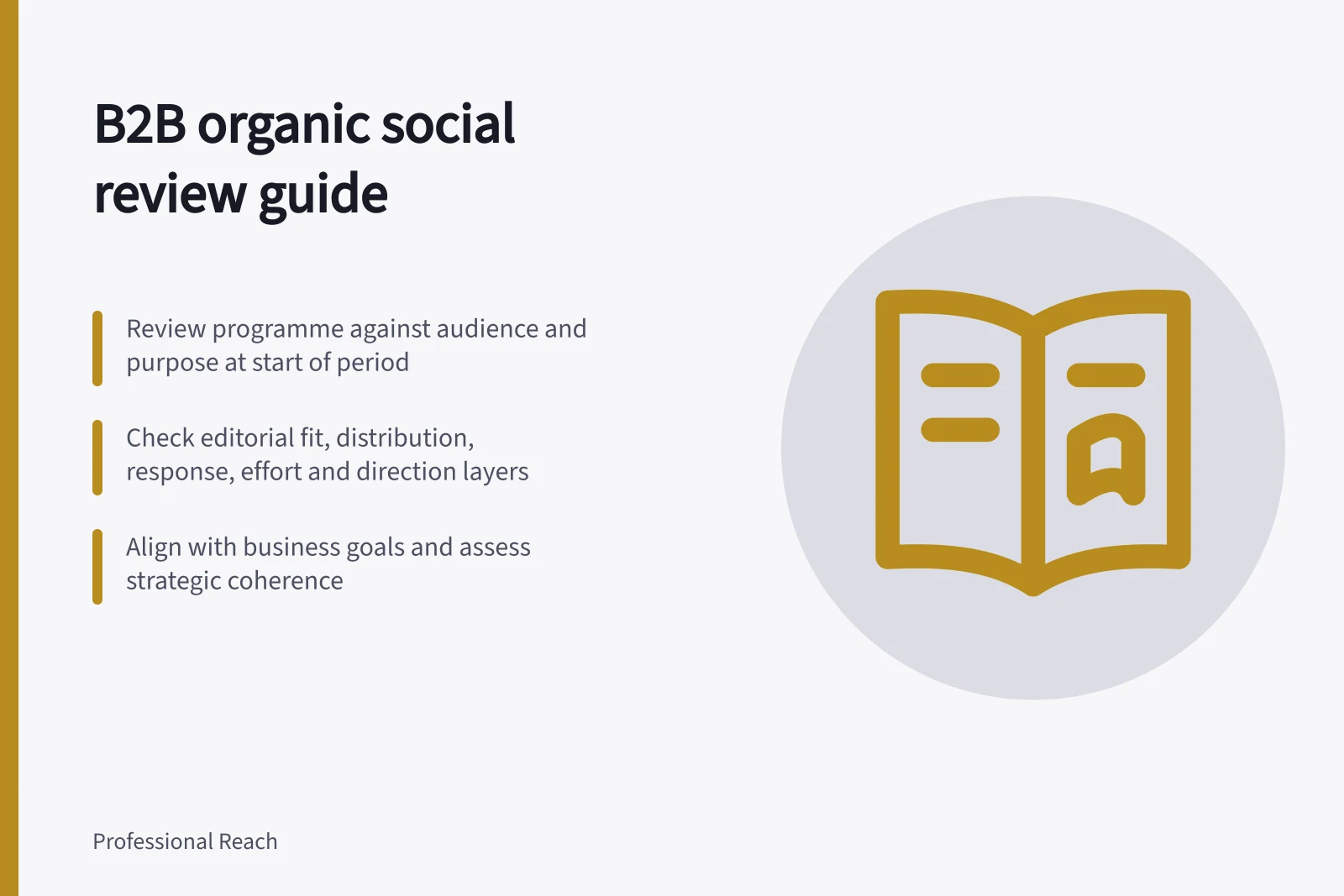
Steps to Conduct a B2B Organic Social Programme Review
- Set the review boundaryDefine time period, audience, purpose, and key activities
- Review in layersAssess editorial fit, distribution, response, effort, and direction
- Check strategic fitAlign programme with business objectives and broader marketing strategy
- Choose next learning stepUse A/B testing, customer behaviour data, and analytics to inform decisions
- Identify decisions to supportDecide whether to maintain, change, pause or stop specific activities
Top Content Types by Engagement in Australian B2B Social Media (2026)
- Industry Insights & TrendsHigh engagement due to perceived authority and relevance
- Problem-Solving GuidesStrong resonance with professionals seeking practical solutions
- Case Studies (with real outcomes)Effective for demonstrating value and building trust
- Regulatory Updates (e.g., ATO, GST changes)High shareability among accountants and legal professionals
Find decisions the review can support
Compare work serving similar audience questions before drawing conclusions from formats or authors. Read the substance of responses: a question about a missing condition may call for a correction, while a relevant enquiry may show that readers need a clearer route to further help.
A quiet post may need another observation period, a clearer answer or a different distribution approach. Silence does not reveal what every reader thought.
Separate editorial problems from distribution and workload problems. If the answer was unclear, revise it. If the intended audience may not have encountered it, examine distribution before rejecting the subject. If the work is difficult to sustain, compare it with another way to answer the same reader need.
Record each programme priority, the evidence behind it, what remains unknown, an owner and a review point. A separate activity-level decision can then determine whether to maintain, change, pause or stop a particular commitment.
In this guide
- Comparing content by the audience problem it solvesGroup B2B social content by the reader problem and decision it addresses, then compare answer quality, responses and gaps.
- Diagnosing reach without relevant responsesCheck audience fit, answer clarity and response routes when a B2B social post has reach but few relevant replies.
- Testing a narrower professional topicDefine a specific professional decision, publish distinct answers and review relevant responses before committing to a narrower social topic.
- Deciding whether an organic social activity is worth maintainingWeigh a social activity's reader purpose, relevant response, workload and alternatives before deciding to maintain, change, pause or stop it.

