Content Operations
Part of LinkedIn newsletters and long-form content
Choosing a recurring newsletter question
Find a professional question with enough depth for a useful LinkedIn newsletter series, then test its audience, boundaries and sustainability.
Choose a question a defined group of professionals faces more than once, with answers that change across situations. It must be specific enough for subscribers to know what to expect and broad enough to support distinct editions. A topic you can fully settle in one article may not need a newsletter.
Find the repeated decision
Start with questions people actually raise in customer conversations, public professional discussions or your colleagues' work. Note who faces each decision, when it arises, what makes it difficult and what evidence you can responsibly use. The recurring unit is the decision, not a broad label such as “business insights”.
For example, a series on supplier handovers might examine who approves an exception, what the receiving team must check, and when a temporary arrangement should end. Each edition would address a different part of the same ongoing problem. These are possible editorial questions, not findings about a particular business.
Building a Sustainable Recurring Newsletter Series
- Identify the repeated professional decisionFocus on decisions professionals face regularly, not broad topics like 'business insights'. Example: supplier handover approvals.
- Capture context and complexityNote who makes the decision, when it arises, why it's difficult, and what evidence can be responsibly used.
- Test the editorial promiseDraft a one-sentence reader promise. Sketch multiple edition questions—ensure they vary meaningfully across situations.
- Verify sustainabilityConfirm you can source reliable expertise, verify claims, and share examples without breaching confidentiality.
- Define clear boundariesState clearly who the newsletter serves and which decisions it covers. Use this to evaluate future content fit.
Test the promise
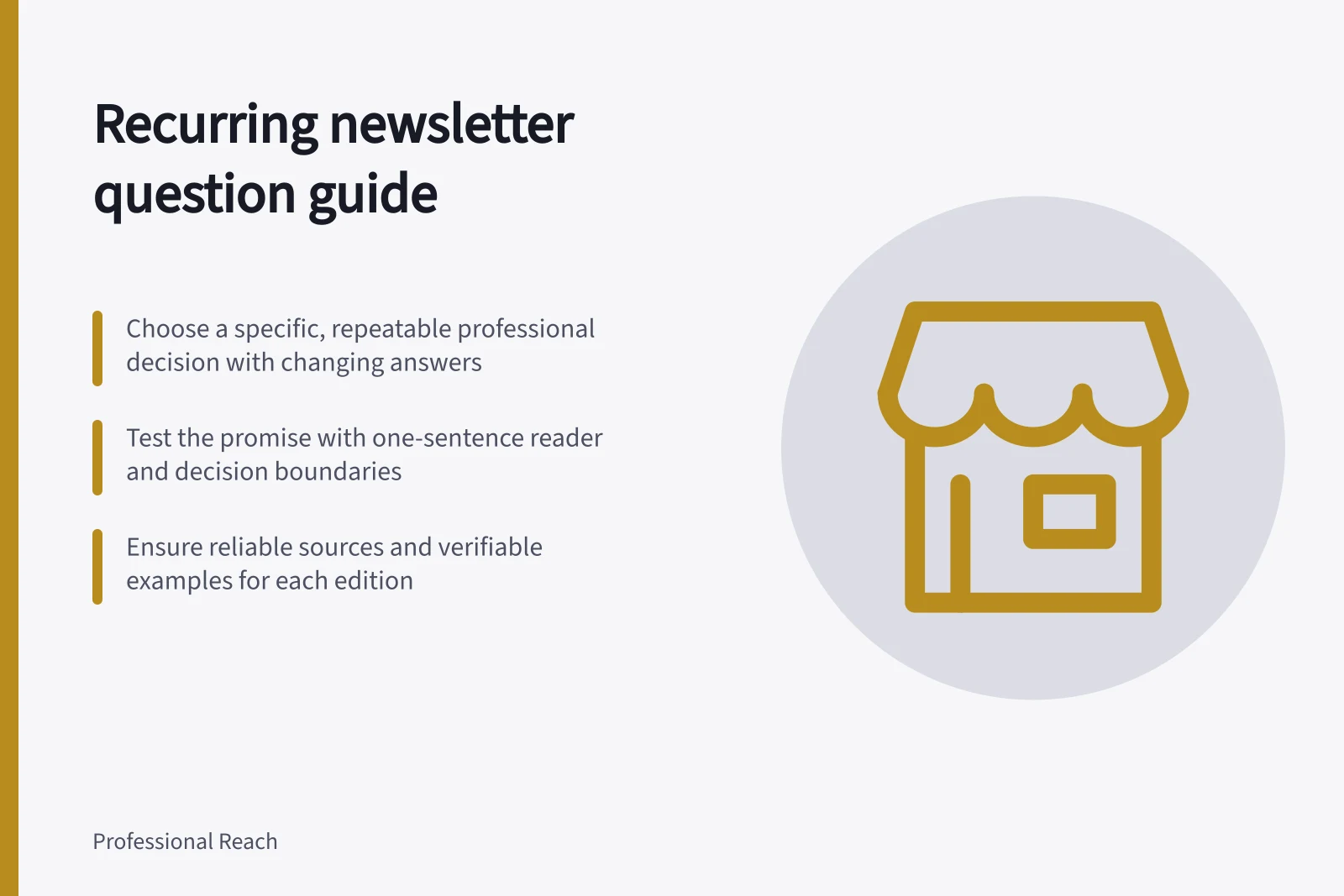
Write a one-sentence description of the intended reader, the repeated decision and its boundary. Then sketch several edition questions. If they all lead to essentially the same answer, the premise may be one strong article. If almost any professional subject fits, narrow the promise until readers can recognise what belongs in the series.
The number of questions is a planning aid, not a platform threshold. What matters is whether the proposed issues differ in a way that would help the same audience make related decisions.
Recurring Newsletter vs. One-Off Article: What’s the Difference?
- Recurring NewsletterAddresses evolving aspects of a single repeated decision; each edition offers distinct insight based on context.
- One-Off ArticleFully resolves a topic; answer is complete and does not change over time.
Check what you can support
A promising theme still needs reliable material. For each proposed issue, identify the expertise or source needed, the claims requiring verification and any example that can be shared without exposing confidential work. A series that depends on information you cannot obtain or publish will be hard to sustain.
Choose an interval that leaves room for research and review.
State the boundary clearly
A newsletter title should identify its continuing theme. Its description should tell prospective subscribers who it serves and which decisions it covers. A focused description gives future issues a useful test: does this question belong here, or would it serve readers better as an individual article?
Keep a credible first question and a distinct follow-up in view. If both can be answered well under the same promise, the idea has the beginnings of a series. If the follow-up merely repeats the first answer, publish the stronger article and keep refining the theme.