Thought Leadership
Part of B2B thought leadership content
Removing generic leadership slogans from a post
Replace broad leadership slogans with a decision, method or condition readers can use. See a practical line-by-line editing test.
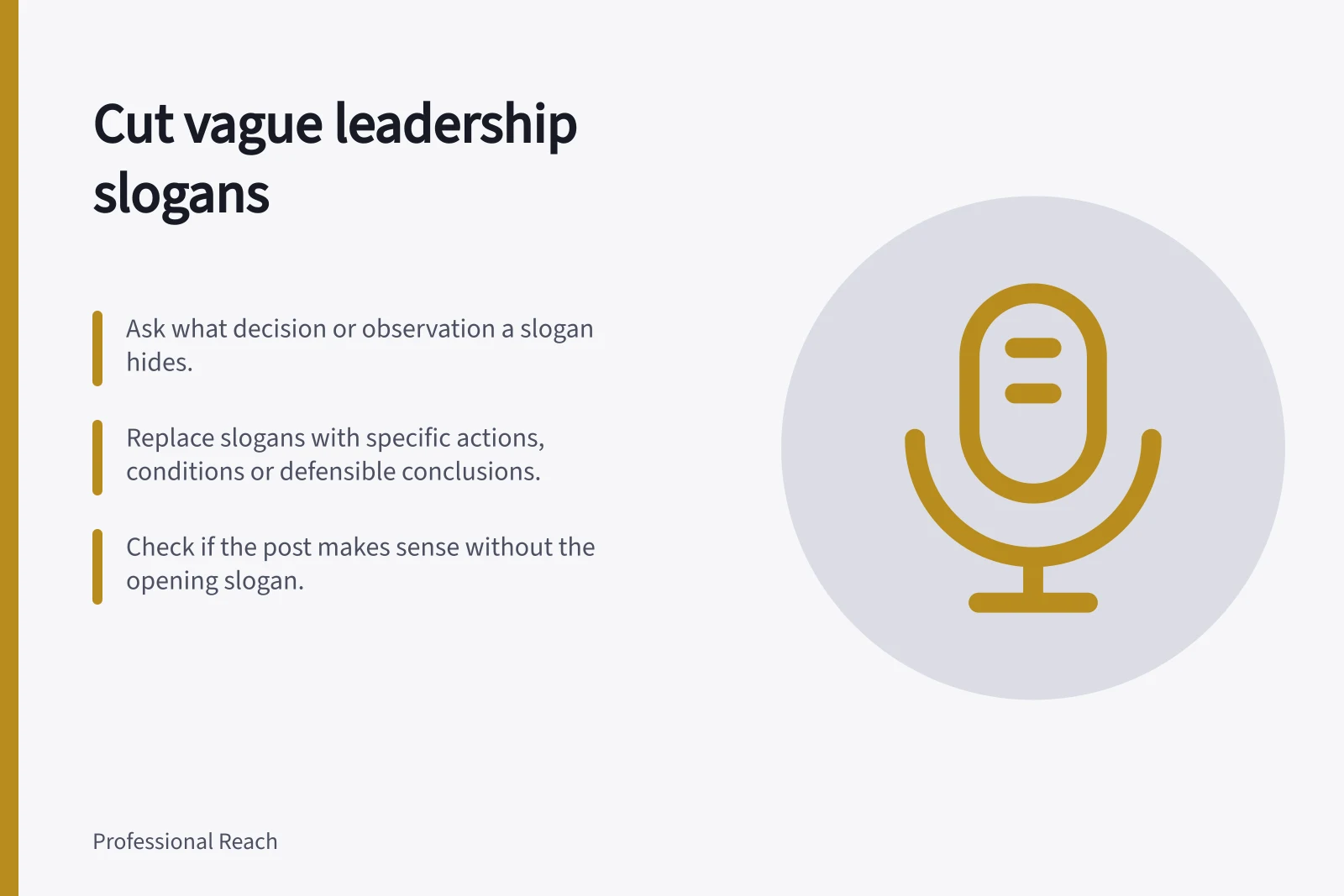
Remove a leadership slogan by asking what decision or observation it conceals. Replace it with the work involved, the condition that matters and a conclusion the author can defend. If no concrete point survives, cut the sentence.
Find the sentence that could belong to anyone
Phrases such as “lead with purpose”, “embrace change” and “put people first” may express a value, but they rarely tell a professional reader what to do in a particular situation. Highlight each sentence that could appear unchanged under a competitor’s name. Ask the author: What happened that made you say this? Which choice did you make? What would someone doing similar work need to check?
An author does not need a sweeping lesson about leadership if they can explain one useful decision. Make their thinking clear enough for a reader to assess.
Editor’s line-by-line test for leadership slogans
- Could this sentence appear under any competitor’s name?Yes → challenge the author
- What specific decision led to this statement?Ask for evidence of choice or action
- Is there a real condition or test that applies here?If not, replace with a check or criterion
- Does the body of the post deliver on what the slogan promises?No → delete the slogan or revise the opening
Rewrite from the underlying action
Consider this invented draft line: “Great leaders empower teams to navigate change.” It offers no setting or test.
If the intended subject is a new approval process, a more useful version might be: “Before changing an approval process, ask who handles exceptions when the usual approver is unavailable.” The rewrite names a check. It does not claim that any organisation performed it or achieved a result.
Another invented line, “Innovation is in our DNA”, might conceal a practical point about evaluating an unfamiliar tool. A draft could instead explain which existing task the tool must improve, which failure would stop a trial and who will judge the result. The author must supply real criteria before publication; the editor should not invent them.
Slogan asks readers to accept… / Ask the author for…
- A value
- A decision that demonstrates it.
- Expertise
- A method or distinction they can explain.
- Success
- A defined, verified observation.
- A universal rule
- The setting and exception that bound it.
Before and after: replacing generic leadership slogans with actionable insight
- Generic sloganGreat leaders empower teams to navigate change.
- Actionable rewriteBefore changing an approval process, ask who handles exceptions when the usual approver is unavailable.
- Generic sloganInnovation is in our DNA.
Keep a value statement when it earns its place
Some posts genuinely announce an organisational principle. In that case, explain what the principle changes: who has responsibility, which choice it affects or what the organisation will decline to do. Check any commitment with the person authorised to make it. A value statement without a practical consequence may belong in a shorter company update rather than a thought leadership argument.
Read the revised post without its opening line. Can a reader identify the issue, the reasoning and the limit?
Then read the opening again. If it promises a lesson the body never delivers, change it. If the body makes its point without the slogan, delete the slogan.
When to keep a value statement in thought leadership content
- Pros: Value statement earns its placeWhen it defines responsibility, limits choices, or clarifies what the organisation will decline to do.
- Cons: Value statement without consequenceMay belong in a company update, not a thought leadership piece. No practical impact = weak argument.