Employee Advocacy
Part of Employee advocacy
Giving employees accurate information they can personalise
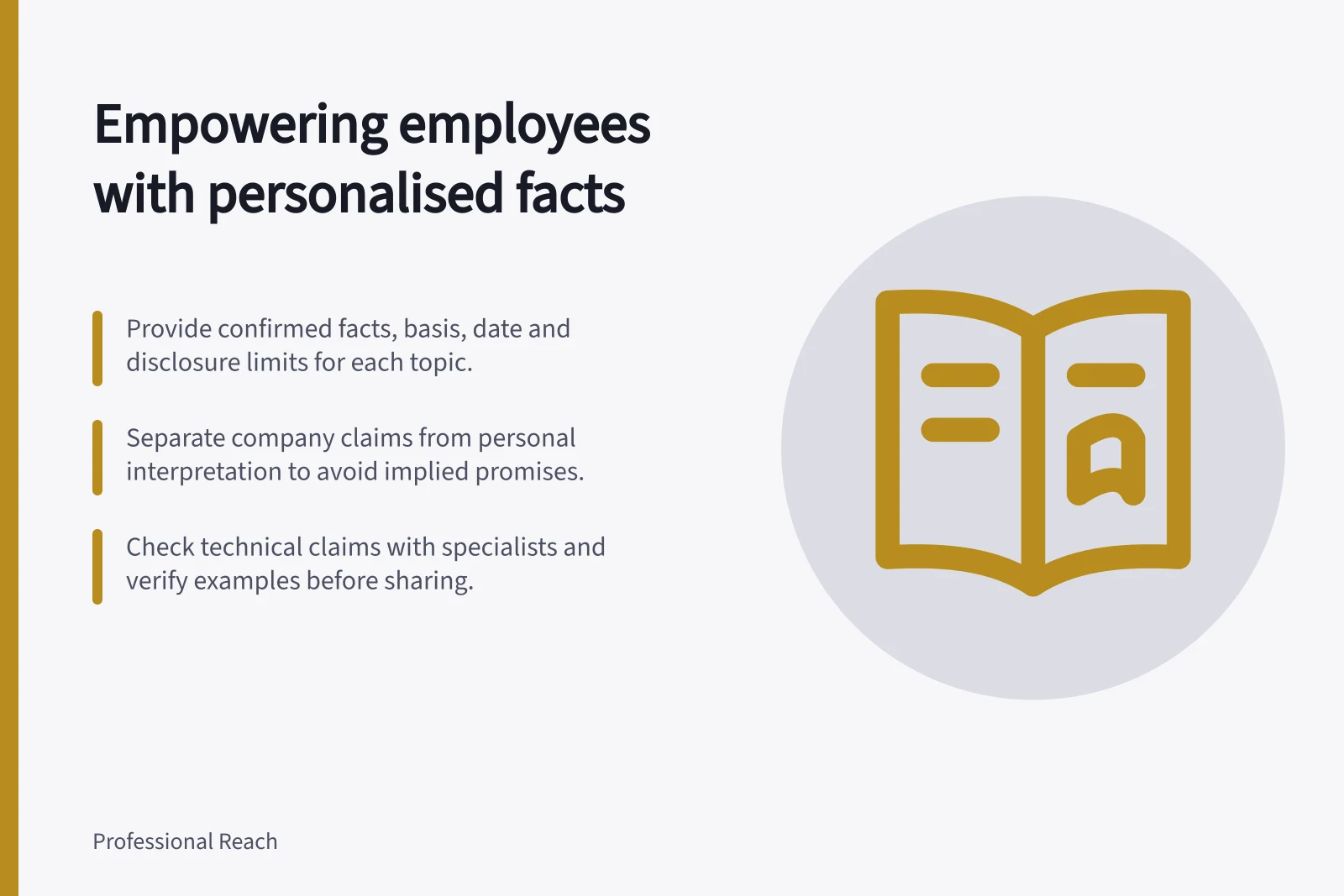
Create concise, verified fact cards with conditions and disclosure limits so employees can share informed views in their own words.
Give willing employees confirmed facts, the limits on those facts and a contact for changes. Let them decide how the information relates to their own work. A short fact card supports different voices without asking everyone to copy one caption.
Key Benefits of Verified Fact Cards
- Improved compliance
- Reduces risk of inaccurate public statements
- Faster employee advocacy
- Employees spend less time verifying facts
- Greater consistency
- All posts align with official company messaging
- Enhanced trust
- Employees feel confident in what they share
Build a fact card for each subject
Include what an employee needs while drafting:
- Confirmed fact:The exact public claim the organisation can stand behind.
- Basis and owner:Where it came from and who can answer a challenge.
- Date and conditions:When it was checked, whom it applies to and any exception that changes its meaning.
- Disclosure boundary:Customer details, figures, plans or internal processes that cannot be made public.
- Correction route:How to flag a change after publication.
“Approved” is not enough if the employee does not know whether a service applies to every customer or only a defined group. Mark a date as proposed when it is not confirmed. Hold a claim whose important conditions remain unresolved.
Fact Card Checklist for Employees
- Confirmed factThe exact public claim the organisation can stand behind
- Basis and ownerSource of the fact and contact for challenges
- Date and conditionsWhen checked, applicable group, and exceptions
- Disclosure boundaryCustomer details, figures, plans or internal processes not for public sharing
- Correction routeHow to flag a change after publication
Separate company facts from personal interpretation
Mark organisational commitments separately from optional prompts for the author. The company Page can announce a confirmed change. A practitioner may explain a question the change raises in their own work, within what they know and may disclose. Their interpretation should not become an implied company promise.
Suppose a company has approved a public explanation of a changed enquiry route. One employee could discuss how they identify the right team for a technical question; another could explain a condition readers should check before using the route. Each would still need the confirmed details. This is an illustrative scenario, not a reported change or result.
Offer prompts such as “Which part of this topic do you handle?” or “What condition would a reader need to know?” Avoid writing a first-person testimonial for someone to paste. The author may reject an angle or describe a narrower role.
Check the claims that carry risk
Ask a subject specialist to check technical statements and the relevant owner to check dates, availability and commitments. Consider whether an example could identify a customer through its context even after names are removed. If a result cannot be verified and shared, explain the decision or method without adding a number.
For a repost, check the original public post and any commentary the employee adds. Added commentary can introduce a new claim. An accurate original post may also become outdated, so tell affected authors about material changes.
Review Process for Employee Advocacy Posts
- Verify technical claimsReviewed by subject specialist
- Confirm dates and commitmentsChecked by relevant owner
- Assess risk of identificationEnsure no customer can be identified even after anonymisation
- Review original post and commentaryCheck for new claims or outdated information
Leave room for the author's view
Before publication, check three things: Is the company information accurate? May the example be shared? Does the employee agree that the post reflects their view?
The appropriate owners review facts and disclosure. The employee decides whether the words are theirs to publish.
Keep a dated fact card and owner so a later correction can be traced. When a fact changes, contact affected authors and agree how to make any needed correction visible.