Content Operations
Part of Organic social and sales collaboration
Recording inbound interest without assuming buying intent
Record the actual social question or action, separate assumptions and protect personal information before assigning a sales status.
Record what the person actually asked, where the exchange happened and what response is due. Keep an observed action separate from a stated need and from any assumption about a purchase.
Record the exchange faithfully
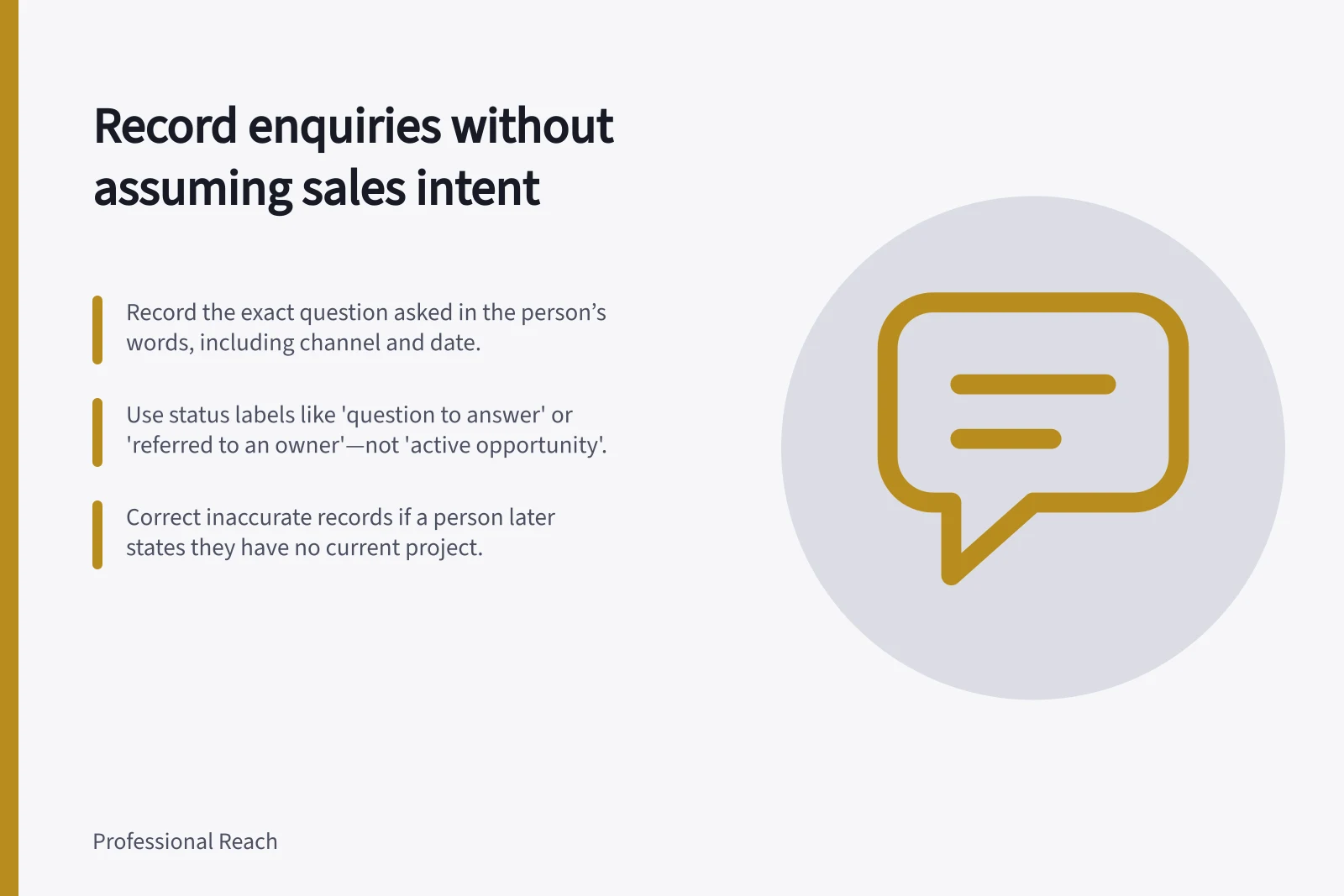
An enquiry note records the channel and date, the question in the person’s terms, the answer already given, the response owner and any next step the person agreed to. For a public comment, keep enough context to answer it without copying unrelated profile details. For a private message, record only what the approved process needs.
Do not turn an aggregate metric into a prospect record. If the person’s own comment or message is visible, record what it says; do not infer a procurement project from their engagement.
| Record separately | Illustrative wording |
|---|---|
| Observed question | ‘Asked in the Page inbox whether the service covers regional sites.’ |
| Stated need | ‘Asked for coverage information.’ |
| Unknown detail | ‘Number of sites and timing not provided.’ |
| Agreed next step | ‘Page admin offered to ask a specialist; awaiting the person’s reply.’ |
This is an invented example, not an actual enquiry or a required CRM format.
What to record vs. what to avoid assuming
- Observed question
- ‘Asked in the Page inbox whether the service covers regional sites.’
- Stated need
- ‘Asked for coverage information.’
- Unknown detail
- ‘Number of sites and timing not provided.’
- Agreed next step
- ‘Page admin offered to ask a specialist; awaiting the person’s reply.’
Give the record a modest status
Statuses such as question to answer, contact requested, referred to an owner and closed or declined describe what the team needs to do. Change the status when the exchange changes. If someone asks for a guide, provide it when appropriate; do not silently turn the request into a demonstration booking.
Name an inbox owner and check for duplicate handling before copying details elsewhere. Avoid pasting an entire private conversation into a broadly accessible sales note.
Limit, update and protect the information
For an organisation covered by the Australian Privacy Principles, personal information collected through social channels remains subject to applicable privacy obligations, including collection, quality and security requirements. Apply the organisation’s access and retention process to the record.
If a later reply shows a note is wrong, correct it where colleagues rely on it. When a person says they have no current project, retain that statement instead of an unsupported ‘active opportunity’ label.