Thought Leadership
Part of B2B thought leadership content
Supporting an industry opinion with evidence
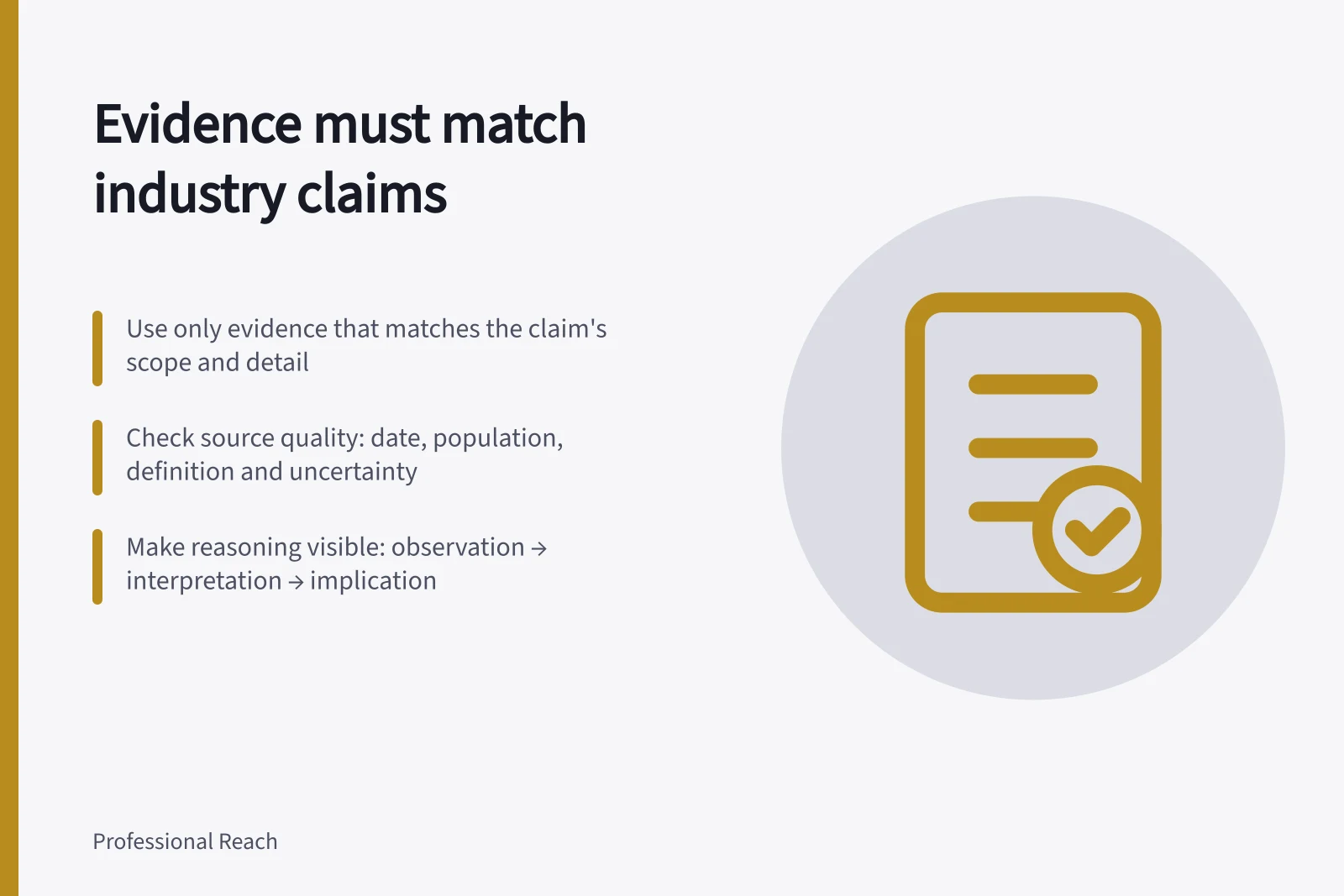
Check the claim, source scope, date and uncertainty before using evidence in an industry opinion. Keep interpretation separate from observation.
Support an industry opinion by writing the precise claim first, then checking whether the available evidence supports it at the same level of detail. A source about one market, period or group cannot establish a universal trend. When the evidence is narrower than the opinion, narrow the opinion.
Identify the kind of claim
Mark every sentence readers might treat as factual. Is it reporting a measured change, interpreting one, predicting what may happen or recommending an action? Each needs a different basis.
A practitioner can explain why they recommend a check. A claim that most firms face a problem needs evidence about those firms.
In a hypothetical draft, “All suppliers are shortening approval periods” is a broad measured claim. An internal team noticing faster decisions on several recent files would not support it.
The team could instead describe the decisions it has faced in recent work, if that account is accurate and shareable. That would convey its experience without inventing an industry trend.
Audit the source before using the finding
For a dataset or study, record the publisher, release date, reference period, geography, population, definition of the measure and any stated uncertainty. Check whether the source has been revised. A change in survey wording or population can make two releases unsuitable for a simple trend claim.
For a public rule or standard, identify the authority, version and who is covered. For an expert comment, name the person’s relevant experience and treat the view as an interpretation. For an internal record, confirm how it was collected and whether the organisation may disclose it. These sources answer different questions.
The Australian Bureau of Statistics’ data-quality framework includes relevance, timeliness, accuracy, coherence and interpretability among its quality dimensions.
Apply those questions to a proposed claim: does the material measure what the sentence says, and can a reader understand its limits? A statistic can be correctly copied yet misleading when its population or period disappears.
Key Data Quality Dimensions from the ABS Framework
- Relevance
- Measures what the claim is about
- Timeliness
- Published within a reasonable timeframe
- Accuracy
- Free from bias and error
- Coherence
- Consistent with other relevant data
- Interpretability
- Clear and understandable to users
Make the reasoning visible
A short argument can follow this sequence: observation → interpretation → practical implication → limit. For example, a verified rise in one type of enquiry could prompt a team to check whether its guidance answers that question. It would not, by itself, prove that the whole industry has changed or that a particular product caused the rise.
Place the qualification where the claim appears. “Among the organisations in this survey” is more useful beside the finding than in a final disclaimer.
If a claim depends on a small subgroup, examine the source’s uncertainty notes before comparing percentages. If the source does not give enough detail for the comparison, leave it out.
Challenge the final draft
Ask a reviewer to underline every claim that sounds broader than its evidence. Can they trace the date, population and measure? Does an opposing explanation remain plausible?
Has the writer turned an opinion into a fact through confident wording? Revise until a reader can tell what was observed, what is inferred and what is recommended. A defensible opinion may be firm; its confidence should match its basis.