Content Operations
Part of B2B social content operations
Keeping a record of approved company facts
Build a dated record of public company claims with evidence, scope, owners, status and a route to review posts when facts change.
Keep reusable company facts in a dated record stating what may be claimed, where it applies and who will notice when it changes. 'Approved' without a basis, conditions and owner is too easy to reuse in the wrong post.
Record-keeping compliance standards (Australia)
- ASIC record-keeping requirement
- All companies must maintain accurate records for at least 7 years
- ACCC enforcement power
- Can demand proof of claims made in advertising or promotions
Give each fact a usable entry
For each public claim, record:
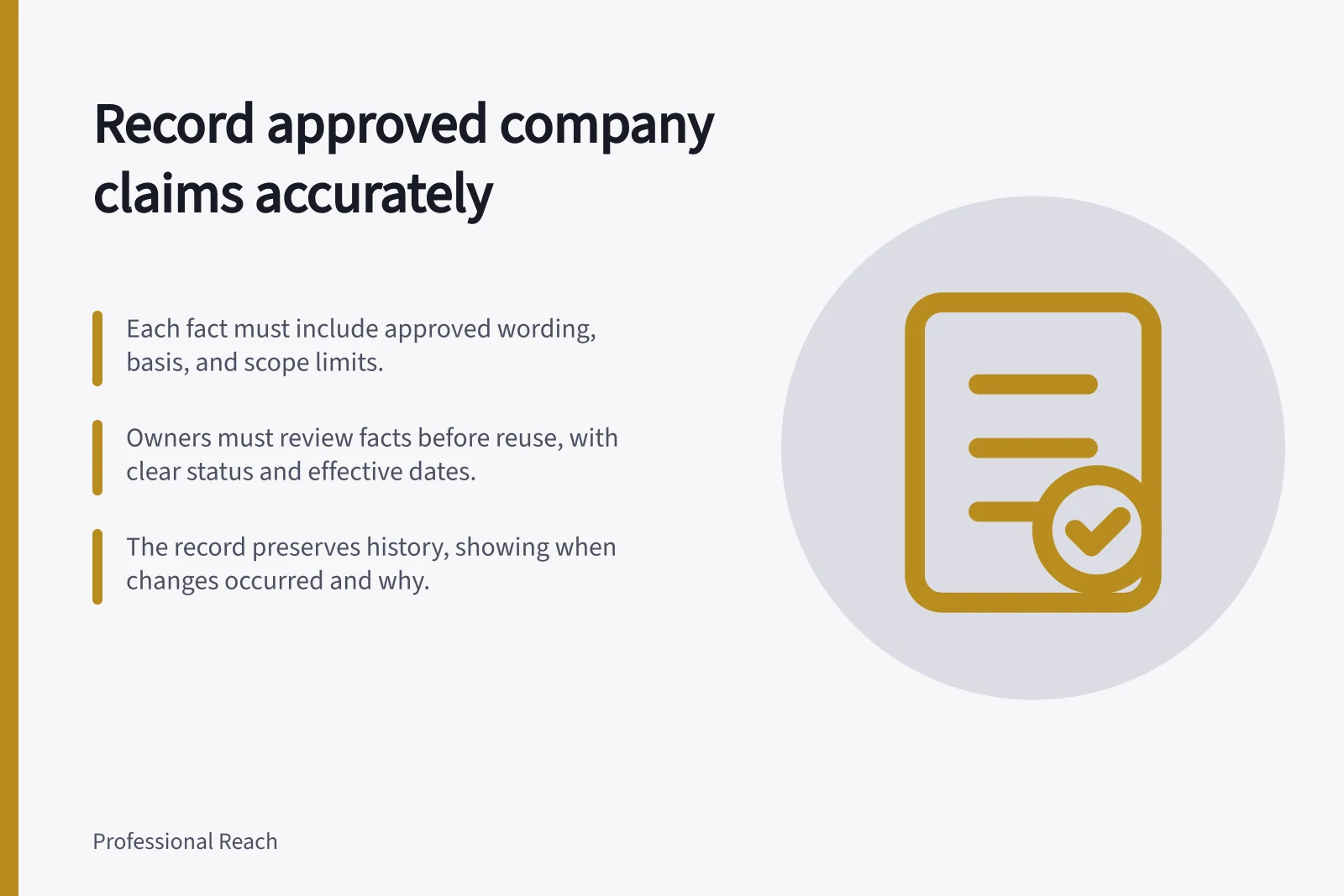
- Approved wording:The precise statement and whether it may be paraphrased.
- Basis:A current internal document, public page or accountable owner that supports it.
- Scope and limit:The product, service, customer group, location, effective date or exception that changes its meaning.
- Owner and review date:Who can reconfirm it and when they last did so.
- Status:Draft, approved, under review, superseded or withdrawn.
- Affected content:Planned and live posts that used it.
These are fields for a team record, not a LinkedIn feature. Keep underlying internal or customer evidence accessible to authorised reviewers without exposing it in public wording.
Preserve the boundary of the claim
Suppose a hypothetical new support route applies only to customers on one service plan from a confirmed date. 'A new support route is available' could imply broader access.
The record should preserve the plan and date and name the owner who can confirm any later expansion. This describes no real offer.
Mark a proposed date as unapproved until it is confirmed. If the evidence supports only a narrow statement, store that statement rather than expecting each editor to remember an exception.
The ACCC can require businesses to back up claims they make about their products or services. A record can help; the final post still needs a check of its overall impression.
Track changes without erasing history
Availability, specifications, measurements and terms can change. The fact owner should flag a material change. The editor can use the affected-content field to find drafts needing another approval and live posts needing assessment.
Keep previous wording, its effective period and the reason for supersession. 'Accurate when published, now changed' differs from 'incorrect when published'. That distinction helps a reviewer decide what readers need to be told without silently rewriting the history of approval.
Review dates should fit the claim. Availability, figures and launch dates may change sooner than a stable explanation of a method. A review date is a prompt to reconfirm, not proof that a fact stayed true until that date.
Lifecycle of an approved company fact
- Initial approval
- Fact is documented with basis, scope, owner and review date
- Effective period
- Fact is published in live content; affected posts are tracked
- Material change detected
- Owner flags update; previous version preserved with reason for change
- Review and reapproval
- Owner confirms new version; status updated to 'approved' or 'superseded'
- Post-update assessment
- Editors check all affected content for necessary revisions
Check each reuse
Before placing an approved fact in a new post, compare the new sentence and context with its recorded scope. A true statement about one service plan can mislead if the post suggests it applies to every customer. A result measured over a defined period cannot become a standing performance promise simply because its number appears in the record.
The record should make the next action clear: use the fact with its condition, ask its owner for a fresh check, or leave the claim out.