Profile Craft
Part of Building a useful professional profile
Choosing profile evidence that supports credibility
Choose work samples, credentials and recommendations that support specific profile claims, with clear limits and context.
Choose profile evidence by the question it helps a visitor answer. A relevant work sample should show your contribution and what someone can inspect. Certificates, recommendations and project examples support different claims; none proves all that a broad expertise description suggests.
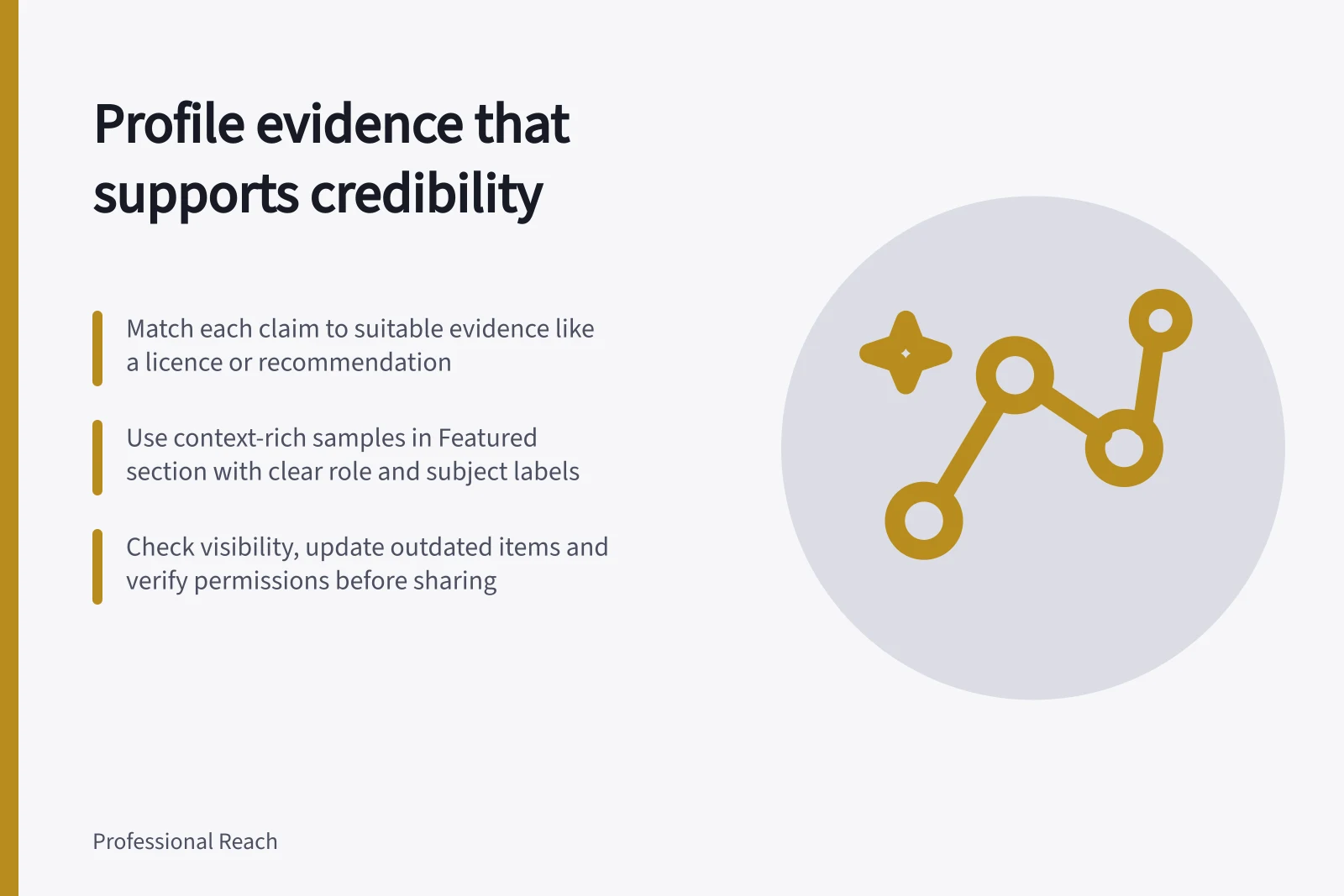
Match each claim to suitable evidence
Write down the claim your profile should make. Ask what a viewer needs to see to assess it. If you claim to explain complex processes clearly, a public guide or presentation may show that skill.
If you describe a professional qualification, a relevant licence or certification entry may identify it, though you should check whether it is current.
If you say you collaborate well, a recommendation from someone who worked with you may offer a perspective. It remains that person’s account.
| Claim to support | Evidence to consider | Limit to state |
|---|---|---|
| “I can explain this process” | A public article, presentation or guide you made | The sample shows one explanation, not every setting you can handle. |
| “I held this responsibility” | An accurately labelled Experience entry and a shareable project description | State your contribution within the team. |
| “I hold this credential” | The relevant licence or certification entry | Check its name and current status before displaying it. |
| “Others have seen my work” | A recommendation from someone with direct experience | It reflects that person’s view, not an independent audit. |
Choose the item that bears on the particular claim, even if it looks less polished than a general award.
Give a work sample enough context
LinkedIn has a Featured section for managing featured samples of your work. Select a sample a visitor can understand without private background. Add a plain title or description identifying the subject, your role and what the sample illustrates.
A shared team document should not be labelled as solely yours.
Before using customer or employer material, check that it is public and that you are allowed to display it. Removing a name may still leave a recognisable project; if the sample depends on confidential details, choose another. A short, approved explanation of your method can be more useful than a screenshot whose context you cannot provide.
Treat social proof with proportion
A recommendation can offer another person’s perspective on your work. When choosing one to feature, consider whether the person has direct knowledge of the work and whether the account supports the claim you want to make. Avoid relying on a scripted compliment or a result they cannot verify.
Skill endorsements are another form of profile evidence. Treat them as a prompt to consider which skills are relevant, then use role descriptions and samples to provide context for those abilities.
Check visibility and maintenance
Check whether the evidence is visible in the viewing context that matters before relying on one item as your only proof.
Review evidence when your focus changes. Remove broken links, outdated credentials and samples that no longer represent your work. Keep enough context for each remaining item to support a specific claim.